XXVI — The constitutional council
Chapitre XXVI
THE CONSTITUTIONAL COUNCIL: GUARDIAN OF THE FRAMEWORK
There must be a body to verify that the rules are respected. But this body must not itself become a political power. It must be independent of the powers it controls, and balanced in its composition.
26.1 — A Composition in Four Quarters
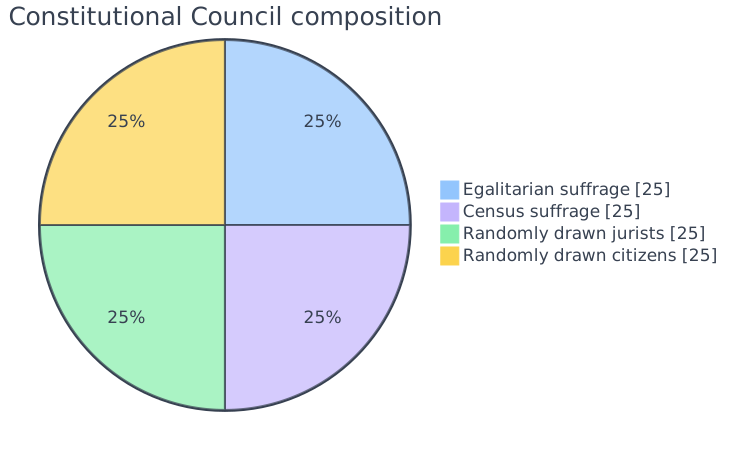
The Constitutional Council is composed of four distinct bodies, each representing a quarter of the institution:
- One quarter elected by direct suffrage (one person, one vote) – represents civic equality
- One quarter elected by census vote – represents tax contribution
- One quarter drawn by lot among qualified jurists – represents neutral technical expertise
- One quarter drawn by lot among all non-jurist, non-elected citizens – represents the raw, unfiltered people
26.2 — The Decision Rule
For a Council decision to pass, two conditions must be simultaneously met:
- A simple majority in three of the four bodies: those elected by direct suffrage, those elected by census vote, and the jurists drawn by lot
- AND a two-thirds majority of all Council members
The citizen quarter drawn by lot votes and counts in the two-thirds calculation, but has no separate threshold to reach.
26.3 — The Constructive Chaos Effect
If the citizen quarter drawn by lot votes unpredictably, the other three bodies must converge strongly to reach two-thirds. The system self-disciplines. If citizens are reasonable, they bring a fresh perspective, uncaptured by organized interests.
In both cases, the system wins: either by forcing consensus, or by injecting fresh air.
26.4 — All Deliberations Are Public
No closed sessions. Every citizen can observe how the Council deliberates and votes.
26.5 — A Strictly Procedural Role
The Council does not legislate. It does not decide political questions. It verifies that constitutional rules are respected. Budget surplus respected? Levy ceiling respected? Recall procedure respected? List of societal domains respected?
It is the guardian of the framework, not a player in the game.
26.6 — The Mutual Veto
A Council decision can be overturned by joint agreement of the Senate AND Parliament by qualified majority. This prevents the Council from becoming a super-power.
26.7 — Constitutional Amendment
The constitutional list of societal domains, as well as fundamental budget rules, can only be modified with a four-fifths majority in each chamber (Parliament AND Senate, separately). This double supermajority is nearly impossible to achieve. Fundamental rules become intangible.
26.8 — Case Study (Empirical Example): The Irish Citizens’ Assembly (2016-present)
Ireland innovated by creating citizens’ assemblies drawn by lot to deliberate on major constitutional questions [128][129]. The 2016-2018 Citizens’ Assembly, composed of 99 citizens drawn by lot plus a chairperson, prepared the referendums on abortion and same-sex marriage—two subjects that deeply divided the country.
What Worked
Renewed legitimacy. Citizens drawn by lot were perceived as neutral and disinterested. Their recommendation to authorize abortion was followed by 66% of Irish voters in the 2018 referendum [129]. The process defused an explosive subject.
Quality deliberation. The 99 citizens heard experts, testimonies, debated over entire weekends. Recommendations were nuanced and informed, not emotional reactions [128].
Statistical representativeness. The lot, stratified by age, gender, region, and social class, produced a “mini-public” representative of the Irish population. Every category was present.
Depolarization. Ordinary citizens, face to face with different people, moderated their extreme positions. The process created empathy and compromise [129].
Exported model. After the Irish success, France (Citizens’ Convention on Climate), Germany, Belgium, and other countries launched similar assemblies.
What’s Problematic
Purely consultative role. The Assembly doesn’t decide—it recommends. Parliament and referendum remain sovereign. Citizens drawn by lot have no real power [128].
Cost and logistics. Organizing deliberation weekends for 99 people over 18 months is expensive. Reimbursements, experts, organization, facilitation.
Selection of subjects. It’s the government that decides which subjects to submit to the Assembly. No citizen self-referral.
Low awareness. Many Irish people didn’t know the Assembly existed. Its impact on public opinion went through media, not direct knowledge.
No permanent institutional follow-up. Assemblies are ad hoc, created for one subject then dissolved. No permanent institution.
What We Keep from the Irish Model
- Drawing by lot as a neutral selection mechanism
- Stratification to ensure representativeness (age, gender, region, class)
- Informed deliberation with expert and witness hearings
- The depolarization effect of face-to-face between different citizens
What We Improve
- Permanent institution: our Constitutional Council permanently includes a quarter of citizens drawn by lot, not ad hoc
- Real power: citizens drawn by lot vote with the other quarters, their voice counts in the decision
- Combination with other legitimacies: the Council mixes drawing by lot, direct election, census election, and legal expertise
- Double majority: citizens drawn by lot cannot block alone, but can prevent an artificial elite consensus
What We Don’t Keep
- The purely consultative role: our citizens drawn by lot have real voting power
- The temporary character: our institution is permanent
- The limitation to societal subjects: our Council verifies respect of all constitutional rules
26.9 — Case Study (Empirical Example) #2: American Constitutional Amendments (1791-present)
The American Constitution provides a deliberately difficult amendment procedure [155][156]. In 235 years, only 27 amendments have been adopted (including 10 on the first day with the Bill of Rights). This constitutional lock offers a precedent for evaluating the rules proposed here.
What Worked
Exceptional stability. The American Constitution is the oldest still in force [155]. Fundamental principles (separation of powers, federalism, individual liberties) have remained intact despite constant political pressures.
Broad consensus required. An amendment requires a 2/3 majority in both chambers of Congress, then ratification by 3/4 of states (38 of 50) [156]. This threshold eliminates partisan or temporary modifications.
Protection of fundamental rights. The Bill of Rights (first 10 amendments) created a foundation of liberties that even overwhelming majorities cannot abolish. Freedom of speech, right to bear arms, protection against arbitrary searches—these rights have resisted over two centuries of assaults.
Evolving jurisprudence. Constitutional rigidity is compensated by a Supreme Court that interprets the text evolutionarily. The 14th Amendment (equal protection) was reinterpreted to abolish segregation, then to recognize same-sex marriage [155].
What’s Problematic
Blocking necessary reforms. Some obsolete provisions (electoral college, Senate representation) are nearly impossible to modify [156]. The system is paralyzed on questions where consensus should emerge.
Too powerful blocking minority. 13 states representing less than 5% of the population can block any amendment. The 3/4 rule gives excessive veto power to minorities.
No periodic revision mechanism. Jefferson proposed constitutional revision every generation (19 years). The United States chose immutability, creating a “constitution of the dead” [155].
Circumvention by interpretation. Text rigidity led the Supreme Court to “legislate” by interpretation. Unelected judges make decisions that the democratic process cannot correct.
What We Keep from the American Model
- The supermajority required to modify fundamental rules
- Constitutional protection of fundamental rights
- Stability as a value in itself
What We Improve
- 4/5 threshold instead of 3/4: even harder to modify, but not impossible
- Two chambers with different legitimacies: census and equal, not territorial
- Recall mechanism: the people can sanction without waiting for an amendment
What We Don’t Keep
- The territorial blocking minority: our system is not federal in the American sense
- Extensive judicial review: our Council verifies rule compliance, it doesn’t reinterpret them
- Total immutability: modification is very difficult, but not impossible
26.10 — Case Study (Empirical Example) #3: German Eternity Clauses (1949-present)
The German Basic Law contains an “eternity clause” (Ewigkeitsklausel, Article 79-3) that makes certain principles absolutely intangible [130][131]. Even a unanimous majority cannot abolish human dignity, the federal structure, or the rule of law.
What Worked
Absolute protection of human dignity. Article 1 (“Human dignity is inviolable”) cannot be modified by any majority [130]. It’s a direct response to Nazi crimes—certain red lines must never be crossed.
Democratic stability. The eternity clause has protected German democracy against extremist attempts. Anti-democratic parties cannot use the democratic process to abolish democracy [131].
Federal structure preserved. The Länder cannot be abolished, even by a Bundestag vote. Federalism is constitutionally guaranteed.
Exported model. Many countries have adopted similar clauses: France (republican form), Italy (republic), Brazil (federalism, direct voting), Turkey (secularism, formerly) [130].
What’s Problematic
Contested definition. What exactly does “human dignity” mean? Courts must interpret, creating a form of government by judges [131].
Impossibility of correction. If an eternity clause turns out to be poorly designed, it cannot be corrected. The system is definitively frozen on this point.
Tension with popular sovereignty. Can one generation really bind all following ones for eternity? The democratic principle suggests that the sovereign people should always be able to decide.
Circumvention by interpretation. As in the United States, extreme rigidity is sometimes circumvented by creative interpretations.
What We Keep from the German Model
- The principle of intangible clauses for the most fundamental rules
- Protection of democratic architecture against itself
- The impossibility of abolishing certain rights through electoral play
What We Improve
- 4/5 supermajority instead of absolute intangibility: extremely difficult, but not impossible
- Precise definitions: budget rules are numbered, not abstract
- Regulated revision mechanism: even the most protected clauses can be modified, but at a nearly unreachable threshold
What We Don’t Keep
- Absolute intangibility: our system allows modification, but at 4/5 of both chambers
- Abstract concepts: “human dignity” is hard to define; our rules are concrete (budget surplus, levy ceiling)
- Eternal binding of generations: each generation can modify the system, if it reaches overwhelming consensus
26.11 — Comparison of Lock-In Thresholds
| System | Modification Threshold | Effective Protection |
|---|---|---|
| USA | 2/3 Congress + 3/4 States | 27 amendments in 235 years |
| Germany (excluding eternity) | 2/3 Bundestag + 2/3 Bundesrat | 67 modifications since 1949 |
| Germany (eternity) | Impossible | Absolute protection |
| Switzerland | Popular majority + majority of cantons | 200+ modifications since 1848 |
| France (5th) | 3/5 Congress or referendum | 24 revisions since 1958 |
| Libertarian Libertarianism | 4/5 of each chamber | To be tested |
Tableau 26.1 — Comparison of constitutional lock-in thresholds
Observation: The proposed 4/5 threshold is more difficult than the American system (which requires separate majorities in two different processes) and close to German intangibility, but without the “eternal” dimension. It’s a balance between stability and adaptability: nearly impossible to modify under normal circumstances, but possible if overwhelming consensus emerges.