XIX — Voting differently
Chapitre XIX
VOTING DIFFERENTLY: REAL-TIME DEMOCRACY
Voting every five years is an aberration. We hand over a blank check, then watch helplessly as our representatives do the opposite of what they promised. Classical representative democracy is intermittent control. What we need is permanent control.
19.1 — Permanent recall
Any elected official, of any kind, can be recalled at any time. Every citizen who voted for a candidate can withdraw their support. If the number of recalls exceeds a certain threshold—say, 55% of initial votes—the official is removed. It’s a negative feedback loop: the system corrects its own drifts in real time, without waiting for the electoral deadline [124].
19.2 — Recalling ministers
Ministers are not elected, but they are recallable by the people. Any citizen can, in the recall booth, express their distrust of a minister. If the recall threshold is reached (calculated on the entire electorate, by equal suffrage—one person, one vote), the minister is dismissed.
Why equal suffrage? Because recalling a minister is a protection, not a budgetary matter. All citizens have the same interest in getting rid of an incompetent or corrupt minister. This is consistent with the Senate’s logic: fundamental rights and protections fall under equal suffrage.
Special case of the Prime Minister. If the Prime Minister is recalled, the entire government falls. A new investiture is required. This is logical: the Prime Minister is the keystone of the government; their fall brings down the edifice.
Other ministers can fall individually without bringing down the government. The Prime Minister then appoints a replacement, subject to Parliament’s approval.
19.3 — Delay proportional to severity
To avoid instability, recall is not immediate. A delay is granted, proportional to the level of unpopularity. At 56% recall, the official has two or three months to turn things around. At 75%, it’s nearly immediate—48 to 72 hours, time to explain themselves. The severity of the sanction corresponds to the severity of the rejection.

19.4 — The right to re-support
Everyone can also cancel their recall. You recalled in the heat of emotion, you calm down, you change your mind. The system absorbs passing fluctuations.
19.5 — The right to run again
A recalled official can run again immediately. This is democratic: if the people can recall, they can also re-elect. It’s also a protection: if the recall was based on fake news, the campaign allows the official to restore the truth and regain trust.
19.6 — Citizen posture votes (empty seats)
The system distinguishes four electoral postures, each creating a distinct institutional effect [148][150]:
| Posture | Intention | Effect on seat |
|---|---|---|
| Black vote | “Nothing satisfies me, I’m blocking” | Systematic vote AGAINST |
| Gray vote | “Nothing pleases me, but I’m not blocking” | Systematic abstention |
| White vote | “I want to avoid minority blocking” | Counterbalances black (Option B) or signal (Option A) |
| Abstention | “I’m out of the game” | No seat, no impact |
Void vote (error, strikethrough): treated as gray vote. Mistakes are not punished.
None of these votes grant recall rights. Those who refuse to choose give up the right to undo.
Black/gray/white/void votes are recorded on the card the same way as a vote with anonymity request. From the outside, these categories are indistinguishable. The stigma disappears.
The white vote: two options
The white vote is not an opinion vote. It is a pro-decision vote.
This document does not choose between these two options. Each has its coherence [149].
Option A — Political signal only
- White counts neither for nor against.
- It modifies neither the numerator (M) nor the denominator (T) of the majority ratio.
- It makes visible a critical participation without withdrawal—a refusal to choose that is not a refusal to participate.
- Black vote can minoritize without counterweight.
Option B — Counterweight to blocking
- The directional majority is determined by FOR vs AGAINST votes from filled seats only.
- Once this majority is established, whites automatically align with it.
- White does not create a majority. It restores a majority that black would have artificially destroyed.
- In case of tie (FOR = AGAINST), whites abstain.
Colombia offers an institutional precedent: Article 258 of its constitution gives the white vote specific legal effects, notably annulling an election if white exceeds the absolute majority [152].
Formalization: effect on the M/T ratio
Let M = FOR votes, C = AGAINST votes, T = total counted, N = black seats, B = white seats.
Without postures (filled seats only): if M > C, the law passes.
With black votes: blacks vote AGAINST → C’ = C + N. A real majority can be artificially minoritized.
Example: 35 FOR, 25 AGAINST, 20 black → 35 / 80 = 44%. The majority (58%) becomes minority.
With white votes (Option B): whites follow the directional majority of the elected.
Continued: 35 FOR, 25 AGAINST, 20 black, 20 white. Directional: 35 > 25 → whites vote FOR. Result: 55 / 100 = 55%. The real majority is restored.
| Posture | Effect on M | Effect on T | Resulting formula |
|---|---|---|---|
| Black | — | +N | M / (T + N) |
| Gray | — | — | M / T |
| White (Option B) | +B if M>C | +B | (M + B) / (T + B) |
The white vote is the counterweight to the black vote. Blocking versus unblocking [147].
19.7 — Protection against sabotage blocking
An anti-democratic party could call for massive black voting to paralyze the system [151]. Several mechanisms discourage this:
No public funding of parties. Parties are funded by their members and donors. Calling for black votes = no elected officials = no money. The saboteur must convince people to fund blocking.
Elected officials’ salary is proportional to their first-round score. For example, if the link is linear, an official at 30% earns 30% of the reference salary. In practice, the curve will probably be logarithmic or square root: 70% is an excellent score and should approach 100% of the salary. This curve is constitutionalized, and its change requires a referendum.
19.8 — Financial status of elected officials
Elected officials have no special advantages. No special pension scheme—they contribute to their own capitalized retirement, like everyone else. No income stacking. One income, modulated by their score, period.
Any modification of elected officials’ reference salary (beyond inflation indexing) must go through a census referendum. Elected officials cannot vote themselves a raise. The same rule applies to Constitutional Council members—elected officials cannot “buy” their controllers.
19.9 — Holding multiple offices
Holding multiple offices is allowed, but limited and regulated:
Maximum two simultaneous mandates. One of the two must be local. This rule values proximity to voters.
No income stacking. The official receives one base income, that of the higher mandate, modulated by their first-round score.
A bonus for dual anchoring. The second mandate provides a supplement that rewards double legitimacy, while remaining capped. The precise calculation is detailed in Appendix C.
19.10 — Majorities: filled seats vs. empty seats
Majority rules depend on the type of decision:
For ordinary laws (simple majority): black seats vote AGAINST, gray seats abstain, white seats follow the directional majority (Option B) or abstain (Option A). A parliament with many blacks will struggle to legislate—unless whites counterbalance.
For constitutional amendments (2/3, 4/5 majority, etc.): only filled seats count. Empty seats—white, gray, or black—are excluded from the calculation. White vote can never facilitate a qualified majority. Black vote can never alone block a constitutional reform. This rule is a safeguard against any “nuclear” use of posture votes.
Quota rule. Abstentions exit the decision quota. Ordinary decisions are made by majority of votes expressing an opinion.
A very empty parliament has little legitimacy and will be under pressure to dissolve. But the system remains functional: the previous budget is renewed (with penalty), existing laws apply, the country doesn’t collapse. It’s the sovereign choice of the people.
19.11 — Materialization in the hemicycle
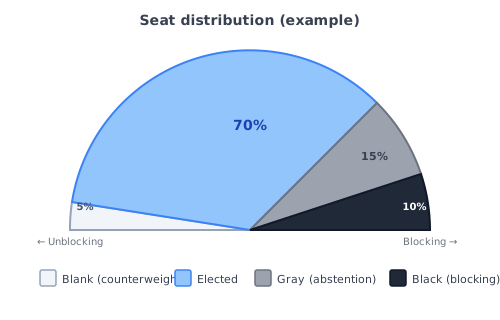
Empty seats are materialized by covers over the armchairs:
| Cover color | Meaning |
|---|---|
| White | Pro-decision seat (counterweight to blocking) |
| Gray | Neutral seat (systematic abstention) |
| Black | Blocking seat (systematic vote AGAINST) |
Spatial arrangement and political alternation. To avoid any symbolic association with a political camp:
- White seats are placed at one end of the hemicycle (for example, far left).
- Gray and black seats are placed at the other end (for example, far right).
- Filled elected officials sit in the center.
- Alternation: at each new legislature, sides are reversed. Odd legislature: whites on the left. Even legislature: whites on the right.
This staging makes visible, permanently, the tension between decision and resistance. White against black. Unblocking against blocking. Citizens following debates see at a glance the level of legitimacy—or its absence.
19.12 — Civic maturity
At first, there will probably be many recalls. The system will be turbulent. Then citizens will learn, as the Swiss learned to use their votes with discernment. The system educates. Recall will become a weapon of last resort, used sparingly. It’s a bet on collective intelligence over the long term.
19.13 — Case study (empirical example): The California recall (1911-present)
California has had since 1911 a popular recall mechanism allowing voters to remove an elected official before the end of their term [125][126]. It’s the most developed American precedent for permanent recall.
What worked
Effective deterrent weapon. The threat of recall disciplines elected officials. Even without succeeding, recall petitions force governors to listen to public opinion [125]. The mechanism’s existence changes behavior.
Successful recall in 2003. Governor Gray Davis was recalled with 55% of votes, replaced by Arnold Schwarzenegger [126]. The mechanism works when unpopularity is real.
Protection against abuse of power. Several mayors and city council members have been recalled for corruption or incompetence. The system offers a local safety valve.
Democratic legitimacy. Recall requires a massive petition (12% of voters from the last election for a governor). This is not a minority whim—it’s a substantial popular expression.
Educational effect. Californians know the mechanism and know they can use it. Civic culture is enriched by this tool.
What poses problems
Prohibitive cost. The 2021 recall of Gavin Newsom cost $276 million [127]. Organizing a special election across a state of 40 million people is ruinously expensive.
Partisan manipulation. Recall is sometimes used as a political weapon rather than correction of abuse. In 2021, the attempt against Newsom was largely partisan—he survived with 62% support [127].
Binary threshold. The mechanism is all-or-nothing: recall or not. No gradation according to severity of rejection. An official at 51% recalls falls as abruptly as one at 80%.
No right to re-support. Once a petition is signed, you cannot withdraw your signature. No mechanism to absorb emotional fluctuations.
Chaotic replacement. In 2003, 135 candidates ran to replace Davis. The replacement system was anarchic [126].
What we keep from the California model
- The principle of popular recall as a fundamental citizen right
- The need for a substantial threshold to avoid minority whims
- The deterrent effect on elected officials’ behavior
- The civic culture the mechanism develops
What we improve
- Permanent and free recall: no special election needed. Recall is continuous, digitally recorded. Near-zero cost
- Delay proportional to severity: at 56%, you have months. At 75%, days. No binary threshold
- Right to re-support: you can cancel your recall if you change your mind
- Right to run again: the recalled official can run again immediately
- Recall linked to active voting: only those who voted for a candidate (any candidate) can recall. Voting black, white, gray, abstaining or explicitly renouncing = no recall right (except for ministers, under equal suffrage)
What we don’t adopt
- The costly special election: our system is continuous, not punctual
- The binary threshold: the response is graduated according to level of rejection
- The impossibility of withdrawing signature: re-support is a right
- Chaotic replacement: the succession process is clarified in advance