XXXIII — Taking action
Chapitre XXXIII
TAKING ACTION: THE TRANSITION
All this looks good on paper. But how do we move from the current system to this one? How do we dismantle an obese State without causing collapse?
33.1 — The Milei model
Javier Milei, in Argentina, has shown that it is possible. He was elected on a program of radical State reduction. And he is implementing it.
The principles:
- Cut to the bone immediately, no “progressivity” that gets bogged down
- Direct communication with the people to short-circuit hostile intermediaries
- Accept transitional chaos as the price of recovered freedom
- De facto monetary competition (dollarization)
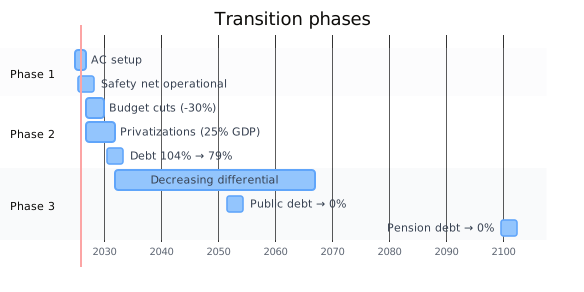 Figure 33.1 — Transition phases
33.2 — The prerequisite: the safety net first
Before cutting, we must have put in place at least a minimum subset of Autonomous Communities—self-financed reintegration structures. This softens the transitional chaos: people who lose their public jobs immediately have a safety net to land in. We are not throwing them into the void. The transition is brutal, but not cruel. The order of reforms matters: it is path dependence [13]—certain sequences open possibilities, others close them.
33.3 — Accepting the pain
The transition will be painful. Public jobs will disappear. Subsidies will cease. Habits will be disrupted. This is inevitable.
But the pain will be short if we accept it frankly. It will be interminable if we postpone it. The choice is not between pain and absence of pain. It is between brief pain and chronic pain.
33.4 — Softening the transition: the sale of public assets
The transition remains a difficult operation. One way to soften it: sell public assets that no longer fall under the sovereign role of the State. Schools, ports, airports, public companies, State holdings, some hospitals, fire stations, administrative buildings—everything that is not strictly necessary for sovereign functions can be sold.
This is not selling off the silverware. It is the logical consequence of refocusing the State on its essential functions. These assets are not “sold to make money”—they are transferred to the private sector because they no longer have a place in a sovereign State. The money recovered serves to repay public debt and finance the pension transition differential (see Appendix F).
Do not sell cheap: take time. A rushed sale would mean selling assets at a discount. It takes several years to obtain a fair price: rigorous evaluation, competitive bidding, favorable market conditions. The schedule must be dictated by public interest, not by budgetary urgency.
Mandatory popular validation. Each significant asset sale must be validated by referendum. The transition will be an unexpected opportunity for those who would like to take undue advantage—cronyism, corruption, favoritism. Only direct popular control can guarantee that sales are made in the general interest and at the right price [107].
The mechanism:
- The State identifies assets to be sold (everything that is not sovereign)
- Each asset is evaluated by independent experts
- A public tender is launched, with total transparency
- The choice of buyer is submitted to referendum (weighted vote, it is a budgetary question)
- If the referendum rejects, restart with new specifications or wait for better conditions
Impact on debt. The simulations of Appendix F (a complete simulator is available) show that an asset sale representing approximately 25% of GDP allows the public debt to drop from 104% to 79% from the first year. For a country like Belgium, reducing debt by 25 points in a single operation is almost unhoped for—no classical austerity policy could achieve this.
Effect on interest. This massive debt reduction has an immediate effect: debt interest decreases proportionally. Less debt = less interest to pay each year = more room to maneuver to finance the pension transition differential. It is a virtuous circle that considerably facilitates the entire rest of the transition.
33.5 — Democratic legitimacy
Milei has proven something else: you can be elected on this program. The argument “it is politically impossible” no longer holds. Peoples, when they are against the wall, can choose freedom.
33.6 — Case study (empirical example): The Milei experience in Argentina (2023-present)
Javier Milei was elected president of Argentina in November 2023 with 56% of the vote in the second round [161][162]. His program: radically reduce the size of the State, dollarize the economy, abolish the central bank. After one year in office, the first results allow a preliminary evaluation.
What worked
Spectacular reduction in inflation. Monthly inflation dropped from 25% (December 2023) to 2-3% at the end of 2024 [162]. This is the most striking and fastest result. Monetary discipline pays.
Budget balance achieved. For the first time in decades, Argentina has achieved a primary budget surplus [161]. Spending has been reduced by 30% in real terms. The “chainsaw” (motosierra) worked.
Elimination of ministries. The number of ministries went from 18 to 9. Thousands of civil servant positions have been eliminated. The state structure has been lightened [162].
Effective direct communication. Milei bypasses hostile traditional media through social networks. He explains directly to the people what he is doing and why. Popular legitimacy remains strong despite austerity.
Economic liberalization. The “DNU” (emergency decree) of December 2023 liberalized entire swaths of the economy: rents, commerce, labor [161]. Regulations accumulated over decades have been eliminated with one stroke.
What poses problems
Brutal recession. GDP fell by 5% in 2024 [163]. Unemployment increased. Poverty temporarily climbed to 53%. The social cost is real.
Absence of structured safety net. Unlike what this document advocates, there were no Autonomous Communities ready to absorb those laid off from the public sector. The adjustment was more painful than it should have been.
Dollarization not realized. The flagship promise to eliminate the peso and the central bank has not been kept [163]. The “currency board” remains an objective, not a reality. Monetary competition is partial.
IMF dependence. Argentina remains dependent on IMF loans to stabilize its situation. Financial autonomy is not yet achieved.
Institutional fragility. Milei governs by decrees, for lack of parliamentary majority. His reforms can be annulled by a successor. No constitutional lock.
What we keep from the Milei model
- Proof that a radical program can be elected democratically
- Speed of execution: cut immediately rather than progressively
- Direct communication with the people to maintain legitimacy
- The result on inflation: monetary discipline works
What we improve
- Prior safety net: our system requires the establishment of Autonomous Communities BEFORE massive cuts
- Constitutional lock: reforms are enshrined in a constitution protected at 4/5, not in revocable decrees
- Monetary competition rather than dollarization: keep a national currency disciplined by the market
- Planned transition: our system provides a sequence (safety net → cuts → liberalization), not a big bang
What we do not adopt
- Absence of prior safety net: brutality without protection is cruel
- Governance by decrees: our system goes through a legitimate constitutional overhaul
- External dependence: our system must be self-sufficient
- Abandonment of national currency: we prefer competition to pure dollarization