VIII — The flat tax
Chapitre VIII
THE FLAT TAX
The tax system of Libertarian Libertarianism rests on a simple principle: a single, visible tax on real enrichment. No tax layer cake, no loopholes, no hidden taxes.
8.1 — The single income tax
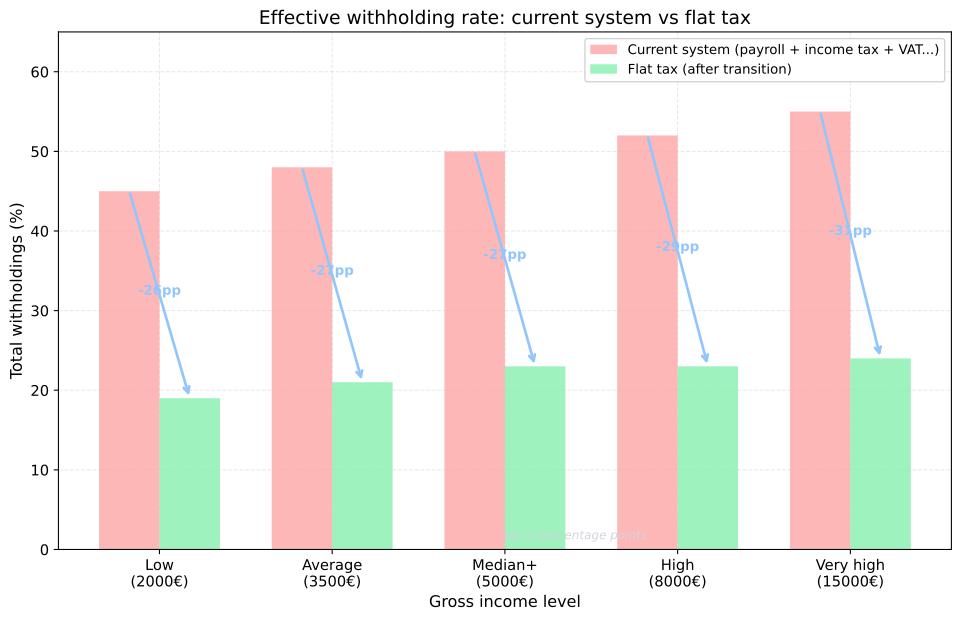
A single income tax, at the same rate for everyone. No brackets, no exceptions, no loopholes. Each euro earned is taxed the same way.
The flat allowance. Before applying the single rate, a flat allowance is deducted from gross income. This allowance—initially set at €500 per month—applies to everyone, regardless of income level. This is not an exemption for low incomes: it is a universal deduction that makes the flat tax effectively progressive without introducing brackets or complexity.
Example with a 25% rate and €500 allowance:
- Income of €2000 → taxed on €1500 → tax of €375 (18.75% effective)
- Income of €5000 → taxed on €4500 → tax of €1125 (22.5% effective)
- Income of €10000 → taxed on €9500 → tax of €2375 (23.75% effective)
Everyone pays, but the allowance represents a larger share of small incomes. The system remains simple—a single rate—while accounting for actual contributory capacity.
Incorruptible indexation. The allowance must evolve with the cost of living. But who calculates this evolution? To prevent any political manipulation, the allowance is indexed to an incorruptible price index (PPD—Pseudo-Dynamic Basket), automatically calculated from anonymized transaction data. The complete mechanism is described in Appendix E.
The flat tax applies to NET income (after allowance). Salaries, dividends, realized capital gains, interest, rents—all income is taxed, but after deducting actual expenses. For rental income: gross rent − expenses − work − loan interest = taxable income. We tax real enrichment, not gross flow. Taxing gross would be confiscatory and punish investment. This principle is constitutionalized—the definition of net income can only be modified at 4/5 of each chamber.
The effect: everyone contributes, so everyone has a voice in census voting. The poor pay little, but they pay—and they vote. The rich pay a lot, and their weight reflects their contribution. The link between contribution and representation becomes transparent.
8.2 — What is taxed
- Salaries (net of social contributions, which become private insurance)
- Dividends (net of tax already paid by the company, if applicable)
- Realized capital gains (at time of sale, not on paper)
- Interest (on savings, bonds, loans)
- Rents (net of expenses, work, loan interest)
- Self-employment income (net of business expenses)
8.3 — What is NOT taxed
- Wealth as a stock. Owning a house, stocks, gold, does not generate tax. Only flow (income, realized gain) is taxed.

- Inheritances. The income that built the wealth was already taxed at creation. Inheritance taxes often force liquidation—family business, farm, house—and constitute confiscatory double taxation. Wealth transfers freely.
- Gifts. Same logic as inheritances.
- Unrealized gains. As long as you don’t sell, you don’t pay. Paper taxation would force selling to pay tax—a disguised spoliation.
- Asset transfers. Buying a house means exchanging money for real estate—an asset transfer, not enrichment. Current “notary fees” are actually transfer duties, a disguised tax on this transfer. They are abolished. Only the notary’s fees for actual work remain (drafting, verification, registration). Effect: mobility is smoothed. You can move for a job, adapt your housing to your family, retire to the countryside—without losing tens of thousands of euros in taxes.
- Fuel. Fuel taxes are regressive and hypocritical: the rich pay without flinching and pollute as much as they want, the poor are strangled going to work. Result: no less pollution, just more inequality. If we want to reduce pollution, we regulate: emission standards, vehicle bans, low-emission zones. The rule applies equally to all. No right to pollute for those who can pay. Harmful behavior should be banned or regulated—not monetized.
8.4 — VAT and all indirect taxes are abolished
The flat tax replaces all indirect taxes:
- VAT (≈20% on each purchase)
- Energy excise duties (electricity, gas, heating oil)
- Fuel taxes (TICPE and equivalents)
- Transfer duties (“notary fees”)
- Property taxes (on property as a stock)
- Taxes on insurance, communications, etc.
These taxes are invisible, complex, and above all regressive: they weigh proportionally more on low incomes. A modest household devotes 100% of its income to consumption and thus pays 20% VAT on everything. A wealthy household saves part of its income and thus partially “escapes” VAT.
Abolishing these taxes therefore massively benefits low incomes. A 20% gain on all purchases, plus the disappearance of energy taxes (heating, electricity, gas for commuting) represents a substantial increase in purchasing power—far greater than what transition simulations measure, since they only count the fiscal differential effect, not the effect of abolishing indirect taxes.
With the flat tax, the citizen sees exactly what they pay to the State. No more hidden tax in every purchase. No more complexity for businesses. No more distortion between consumption and savings.
8.5 — Reasoning in real purchasing power
A change in tax framework changes the relevant metric. Comparing nominal amounts between two different tax systems is misleading.
Why nominal comparisons are misleading
In a system with 20% VAT, an income of €1,500 buys €1,250 worth of goods and services (the rest goes to VAT). In a system without indirect taxes, the same real purchasing power requires only €1,250 in nominal income.
This gap applies to all income flows:
- Salaries. A nominally lower salary in the new system may offer equivalent or higher purchasing power.
- Pensions. A €1,200 pension without indirect taxes may be worth as much as a €1,500 pension in the old system.
- Capital income. Dividends, rents, interest—all are affected the same way.
The methodological principle
The model presented here reasons in net purchasing power and real flows, not in gross amounts inherited from a different tax framework.
This approach:
- avoids false debates about “income cuts” that are not;
- allows honest evaluation of each citizen category’s situation;
- makes international comparisons more relevant.
Consequence for transition financing
This purchasing power neutrality has a major implication for any transition from the old system:
- Required real flow is reduced. If one euro in the new system equals €1.20 in the old (thanks to indirect tax abolition), nominal financing needs decrease—without loss of purchasing power for the beneficiary.
- Transition effort is lightened. Less nominal flow to pay means less effort for contributors.
- Effective economic rights are fully respected. This is not a “reduction”—it is an adaptation to the new tax framework.
This logic applies universally: pensions, benefits, ongoing contracts. It is a structural lever for reducing transition costs, without sacrifice for beneficiaries.
Application to pension transition. Appendix E applies this principle to financing pensions inherited from the old pay-as-you-go system. The temporary differential to finance is lightened by this purchasing power neutrality.
8.6 — The effect on business competitiveness
The reform does not only concern individuals. Businesses benefit from a double virtuous effect.
Reduction of employer contributions. In the current system, employer contributions represent about 25-30% of gross salary on top. These charges increase labor costs and penalize employment—especially for low wages where the relative burden is maximum. In the new system, social insurance (health, unemployment, pension, education) becomes private insurance paid by the worker from their net salary. Employer contributions disappear. The employer pays only gross salary.
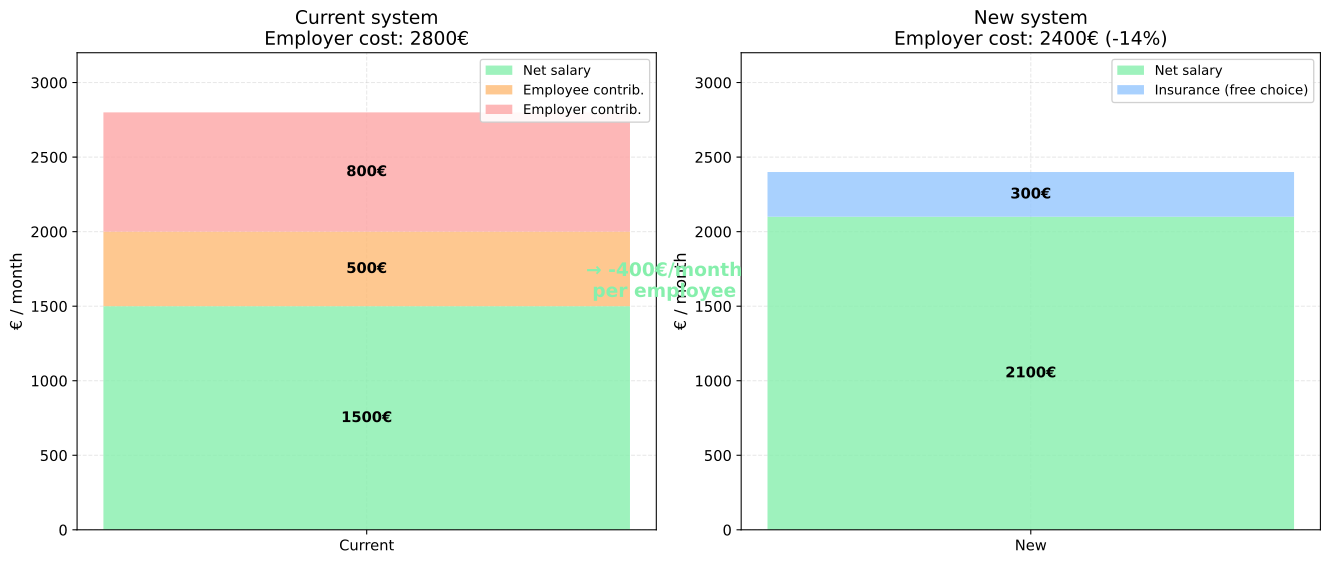
Immediate effect on competitiveness. This labor cost reduction makes businesses more competitive—both on the domestic market and for export. Locally made products become cheaper. Businesses can invest, hire, or lower prices.
Domestic market boost. Simultaneously, households—especially low incomes—see their purchasing power increase substantially (+€142/month for a €2000 salary from day one). Yet modest households consume nearly all their income. This additional demand directly benefits local businesses: shops, services, crafts. Domestic market growth feeds business growth that feeds it—a virtuous circle.
Double benefit for exports. Exporting businesses win on both fronts: reduced production costs (fewer employer contributions) and strengthened domestic demand (enabling economies of scale). They become more competitive against foreign competition.
Corporate tax: same rate, same allowance. The flat tax applies to businesses exactly as to individuals: same single rate on net profit, same flat allowance. A micro-enterprise with €1000 monthly profit benefits from the allowance like a modest employee. A large company with millions in profits pays at near-nominal rate. The formula is identical for all—only the result differs.
This uniformity has a major macroeconomic advantage: the system becomes indifferent to income distribution. Whether GDP is distributed among many small incomes or few large incomes, total tax revenue remains predictable: it is (GDP − sum of allowances) × rate. Simulations do not need to model distribution—they work directly on aggregates.
Allowance and debt repayment. The flat allowance applies only to the flat tax—that is, the State’s current budget. The differential rate, which repays debts (transition debt, nominal pension debt, inherited public debt), is calculated on gross income, without allowance. Consequence for simulations: at the macroeconomic level, the allowance has no impact on debt repayment calculations. Only the differential counts, and it applies uniformly. The allowance is already integrated into State current budget calibration from the start.
Natural anti-abuse. Can one multiply companies to multiply allowances? In theory yes, but it is not profitable. The tax saving per additional company is small: allowance × rate. With a €500/month allowance and 20% rate, each fictitious company saves only €100/month—far less than administrative costs (accounting, declarations, management fees). The system naturally protects itself: the modest allowance and low rate make optimization by entity multiplication unprofitable.
8.7 — Vacant housing: incentive, not wealth tax
Wealth as a stock is not taxed—that would contradict the system’s principles. Exception: housing vacant beyond a defined duration must be put into circulation.
This is not a wealth tax. It is an incentive to generate the flow (rent) that will be normally taxed. At most, you pay as if you were renting—never more. Might as well actually rent, choose your tenant, and keep the net rent.
The mechanism includes a grace period, then a progressive tax on estimated rental value, up to a ceiling aligned with the flat tax rate. Work suspends the delay. Actual rental resets the counter. Mechanism details (phases, tiers, anti-yo-yo rules) are presented in Appendix H.
What is constitutionalized: The principle (progressive incentive, ceiling aligned with flat tax, anti-yo-yo). Exact settings are local legislative calibration.
8.8 — Rate modification
The flat tax rate is not inscribed in the constitution, but its modification requires a qualified majority:
- Increase: 2/3 of Parliament (census). Those who pay most have more weight, and they must massively consent
- Decrease: 2/3 of Senate (equal). Every citizen can defend their property
Why this asymmetry? The Senate protects fundamental rights. Property is one. Lowering taxes protects property—so the Senate (equal) decides. Raising taxes takes property—so those being taken from must massively consent (census Parliament).
This is not a technical trick. It is the direct consequence of the founding principle: property is a right to defend, not a state concession.
This asymmetric mechanism creates a virtuous bias: raising taxes is difficult, lowering them is easier. The system naturally leans toward fewer levies.
8.9 — Tax conciliation in case of disagreement
It may happen that the Senate votes a decrease and Parliament an increase. This is not absurd: in a system without massive redistribution, the less wealthy might want to pay less tax, while the wealthier might consider that a well-funded sovereign State (police, justice, diplomacy) is good for the economy and their investments.
In case of disagreement, a joint committee is convened:
- Composition: equal number of senators and parliamentarians, designated by each chamber
- Voting rule: each member has one vote (no census weighting in committee). Simple majority to adopt a compromise
- Deadline: a deadline is set to find agreement, extendable once by vote of both chambers
- If agreement is found: the compromise rate is submitted to both chambers for ratification by simple majority (no longer need 2/3, the compromise has already been negotiated)
- If no agreement is found: the status quo applies. The rate remains unchanged. A new attempt is possible in the next legislature, which can be triggered by recall.
This mechanism forces dialogue between the two legitimacies. No one wins automatically. The status quo protects against non-consensual changes.
8.10 — Case study (empirical example): Baltic flat taxes (1994-present)
Estonia was the first European country to adopt a flat tax in 1994, followed by Lithuania (1994) and Latvia (1995) [77][78]. These three countries offer 30 years of hindsight on a single-rate tax—a valuable empirical precedent [76], even if the post-Soviet context limits direct transferability.
What worked
Administrative simplicity. The Estonian system fits on one page. Tax returns take a few minutes online [77]. Complexity disappeared. Compliance costs plummeted.
Strong economic growth. The Baltic countries experienced average growth of 5-7% per year in the 2000s [78]. The flat tax helped attract investments and formalize the underground economy.
Reduced tax evasion. When tax is simple and moderate, the incentive to cheat decreases. Estonia saw tax revenues increase despite a lower rate [77].
Economic neutrality. No distortion between income sources. Capital and labor are taxed at the same rate. Economic decisions are no longer dictated by tax optimization.
Political stability. The system survived multiple political alternations. Even left-wing parties did not abolish the flat tax—proof of its popular acceptance.
What poses problems
Abandoned progressivity. The Baltic countries eventually reintroduced elements of progressivity [79]. Lithuania adopted a second rate in 2019. Latvia followed. Estonia resists but introduced an exemption threshold.
Insufficient revenues. Initial rates (24-26%) were not enough to fund European-quality public services. Pressure to increase revenues led to adjustments [79].
Perceived inequalities. The billionaire and the worker pay the same percentage. Politically, this is hard to defend against egalitarian discourse.
Context dependence. The flat tax was adopted after Soviet collapse, in a clean-slate context. Importing this model into a country with an established tax system is more complex.
No constitutional lock. Rates were modified several times by simple law. Stability is not guaranteed.
What we keep from the Baltic model
- Radical simplicity: one rate, no loopholes, no brackets
- Economic neutrality: capital and labor treated equally
- Effect on underground economy: a simple tax reduces evasion
- Proof of feasibility: 30 years of real operation
What we improve
- Constitutional lock: the flat tax principle is inscribed in the constitution. No return to progressivity without 4/5 majority
- Protective asymmetry: raising the rate is harder than lowering it
- Levy ceiling: the single rate fits within a global constitutional ceiling
- Universal flat allowance: instead of an exemption threshold (which creates a class of non-contributors), an identical allowance for all preserves the citizen-contribution link while making the system effectively progressive
What we don’t adopt
- Easy rate modification: our system locks the principle, not the exact rate, but protects against increases
- No global ceiling: Baltic countries have no constitutional levy ceiling
- Pure exemption threshold: our flat allowance is different—everyone receives it, even high incomes. It does not create “non-contributors”
8.11 — Case study (empirical example) #2: Hong Kong (1947-present)
Hong Kong has maintained a flat tax on personal income since 1947 [163]. With a maximum rate of 15% (and often less thanks to deductions), it is one of the simplest and lowest tax systems in the world among developed economies.
What worked
Exceptional economic growth. Hong Kong went from a poor colonial port to one of the world’s wealthiest economies [163]. GDP per capita exceeds most European countries.
Tax stability. The maximum rate of 15% has never been raised in 75 years. This predictability attracted investments and talent.
Radical simplicity. The tax return fits on a few pages. Compliance costs are minimal.
Sufficient revenues. Despite low rates, Hong Kong has always generated massive budget surpluses, accumulating $500 billion USD in reserves [163].
No VAT. Hong Kong never introduced VAT, contrary to IMF recommendations. Simplicity was preserved.
What poses problems
Inequalities. Absence of tax redistribution contributed to extreme inequalities. Hong Kong’s Gini coefficient is among the highest of developed economies.
Unaffordable housing. Property prices are among the highest in the world. Low property taxation contributed to speculation.
Dependence on land revenues. The government draws much of its revenue from land sales, not tax. This model is not reproducible everywhere.
Absence of democracy. Hong Kong never had full universal suffrage. The tax system was never subjected to electoral pressure—which partly explains its stability.
End of autonomy (2020). Integration into mainland China threatens the tax model. The future is uncertain.
What we keep from the Hong Kong model
- Low-rate flat tax (15% or less) as an objective
- Absence of VAT: our system abolishes all indirect taxes
- Tax stability over several decades
- Administrative simplicity
What we improve
- Full democracy: our system is democratic, not technocratic
- Land regulation: vacant housing is incentivized to return to the market
- Revenue diversification: no dependence on land sales
What we don’t adopt
- Absence of democracy: popular consent is essential
- Tolerance of extreme inequalities: autonomous communities provide a safety net
- Land revenue model: not reproducible elsewhere
8.12 — Case study (empirical example) #3: Russian flat tax (2001-2020)
Russia adopted a 13% flat tax in 2001 [132][133], moving from a progressive system (up to 30%) to a single rate. It is one of the few countries to have made this transition in a difficult economic context.
What worked
Tax revenue explosion. Contrary to predictions, income tax revenues increased 25% in real terms the first year, then continued growing [132]. Simplification reduced evasion.
Economy formalization. Millions of Russians working off the books declared their income. The cost of compliance became lower than the risk of evasion [133].
Simplicity. The return became trivial. Administrative costs plummeted.
Political acceptability. The 13% rate was low enough to be accepted by all, including the rich who previously paid 30%.
What poses problems
Partial abandonment in 2021. Russia reintroduced a second 15% rate for incomes above 5 million rubles [133]. The return of progressivity shows the lock was insufficient.
Authoritarian context. The reform was imposed by presidential decree, not voted democratically. Stability rested on personal power, not an institutional mechanism.
No levy ceiling. Other taxes (20% VAT, social contributions) continued to weigh. The income flat tax was only part of the system.
Rent economy. Oil revenues funded the State, not income tax. The model is not exportable to economies without natural resources.
What we keep from the Russian model
- Proof that the flat tax increases revenues through formalization
- Social acceptability of a sufficiently low single rate
- Simplicity that reduces evasion
What we improve
- Constitutional lock: our system prevents return to progressivity
- Democratic context: the reform must be voted, not imposed
- Abolition of all taxes: not just income tax
What we don’t adopt
- Absence of lock: Russia could return to two rates in 2021
- Authoritarian context: our reform is democratic
- Dependence on natural resources: our model works for all economies