VII — Protecting ourselves without the welfare state
Chapitre VII
PROTECTING OURSELVES WITHOUT THE WELFARE STATE
Libertarianism is often accused of abandoning the most vulnerable. This criticism would be valid if we eliminated all protection without putting anything in its place. But there is a different path: market-based protection, with a self-financed safety net.
7.1 — Constitutional common baselines
Before detailing each insurance, a fundamental principle: common baselines are enshrined in the constitution. This prevents Parliament from inflating them indefinitely—which would recreate the welfare state through the back door.
What is constitutionalized:
- The principle of the common baseline (minimum coverage)
- The maximum scope of the baseline (limited list of what can be included)
- The pooling mechanism between insurers
- The prohibition on expansion of the baseline without a 4/5 majority in each chamber
What remains legislative: technical parameters (amounts, durations, rates), inflation adjustment, practical modalities.
7.2 — Pricing: free but pooled
For each insurance, the principle is the same:
- Free pricing: insurers set their prices, in competition
- Pooling of heavy risks: each insurer contributes to a common pot proportionally to its number of insured; the pot compensates those who have more costly profiles
Result: the insurer no longer has an incentive to select “good risks”. It makes money by being efficient, not by sorting clients. Competition plays on service quality, management efficiency, and supplementary benefits. This mechanism neutralizes two classic pitfalls of insurance markets: adverse selection (insurers flee costly profiles [59]) and moral hazard (the insured overconsumes since they don’t pay directly [58]).
7.3 — Health insurance
Mandatory for all. Without insurance, the free rider shows up at the emergency room and makes others pay. The common baseline guarantees essential care.
The hybrid system for children. The child did not choose their parents or their health problems. Several funding sources, combinable:
- Parental insurance: the parent contributes for the child
- Child insurance: the child is enrolled, repays from future income
- Mix: depending on means and needs, adjustable over time
The child repays what they cost—no modulation based on future income, otherwise it’s a disguised tax. If repayment is too heavy, they can enter an autonomous community to pay off their debt (see section V-bis).
The parent who becomes wealthy can take over and catch up on arrears, freeing the child from their debt faster.
Child insurance is retroactively activatable in case of emergency: we treat first, regularize later.
Severe chronic diseases: the State intervenes. Childhood cancer, cystic fibrosis, type 1 diabetes can generate hundreds of thousands of euros. No individual can repay that. The State covers severe chronic diseases defined in the constitutional baseline.
Sanction for consanguinity. Consanguineous marriages drastically increase the risk of genetic diseases. If the State pays for chronic diseases, it can sanction behaviors that deliberately multiply them. Consanguineous parents who knew or should have known bear the additional costs. Good faith cases (unknown adultery, clinic error, adoption, unknown origins) are excused. No retroactive effect before the transition.
7.4 — Unemployment insurance
Optional, with explicit opt-out. By default, you are insured. An active step is required to unsubscribe. This protects the absent-minded while preserving freedom.
A common baseline guarantees minimum duration and benefit level for those insured. This baseline is pooled among insurers. Competition plays on supplementary benefits and support.
Insurers have an incentive to help their clients find work quickly: the shorter the unemployment, the less they pay. The system self-optimizes.
Those who choose not to insure themselves accept their choice: in case of job loss, they can join an autonomous community (see section V-bis).
7.5 — Education insurance
Flexible hybrid system. Homeschooling is a right. Forcing a single education insurance would amount to imposing a model.
Several funding sources, combinable and adjustable over time:
- Parental insurance: the parent contributes, insurance pays
- Child insurance: the child is enrolled, repays from future income
- Child’s work: student job, work-study, apprenticeship
- Direct loan: classic student loan
Example pathways:
- Primary/middle school: parental insurance
- High school: mix parental insurance + job
- Higher education: child insurance + job + some parental insurance
- Or any other combination depending on each person’s means and choices
Possible transitions:
- Parent loses job → switch to child insurance
- Child finds a good student job → reduce insurance
- Parent becomes wealthy → takes over and can catch up on arrears
The child repays what they cost. If repayment is too heavy, they can enter an autonomous community.
Parents in autonomous community. The organization can supplement them: either by directly paying the children’s education insurance, or by giving money to parents with destination control (strict earmarking). The second option preserves their dignity as parents who “pay for their children.”
What remains mandatory: periodic checks (verified homeschooling), the minimum knowledge baseline (reading, writing, arithmetic).
Trainings without job prospects disappear. Funding follows results: professional integration.
Theoretical foundation. Murray Rothbard demonstrated that mandatory free education, far from liberating, creates dependence on the State and standardizes pathways [6]. The system proposed here restores parental responsibility and diversity of pedagogical approaches.
7.6 — Pension capitalization
Optional, with explicit opt-out. Same logic as unemployment insurance: insured by default, active step to unsubscribe.
Each person saves for their own retirement via private pension funds. No hidden debt, no untenable promises, no generational conflict. What we have saved, we recover.
Those who choose not to save accept their choice: old and without resources, they can join an autonomous community.
For immigrants arriving late: economic immigration can be filtered by age or require starting capital. Late arrivals may be subject to higher contributions to catch up. Political refugees enter the general system—autonomous communities welcome them if they lack means.
Why capitalization, not pay-as-you-go? This document totally rejects the pay-as-you-go system. Pay-as-you-go is structurally unsustainable: it’s a pyramid-type system that depends on perpetual demographic growth. Worse, it enslaves future generations—children are forced to contribute to pay their elders’ pensions, without any choice. The implicit debt of pay-as-you-go systems typically represents 200 to 300% of GDP—a time bomb. It’s a problem of intertemporal constraint: today’s promises commit future resources that no one has provisioned [64].
The transition from the current system (pay-as-you-go) to capitalization is possible. Appendix F provides rigorous demonstration: a simulator has modeled this transition for 7 European countries (Belgium, France, Germany, Italy, Spain, Netherlands, Poland), with explicit and verifiable parameters. Result: the transition takes 70 to 85 years depending on the country, with a temporary differential of 8-11% of GDP for 40 years—then all debts converge to zero.
7.7 — Case study (empirical example) #1: Swiss health insurance (LAMal, 1996)
Switzerland reformed its health system in 1996 with the Health Insurance Act (LAMal) [60][61]. This system combines mandatory insurance, competing private insurers, and a risk compensation mechanism—a model close to the one proposed here.
What worked
Universal coverage without state monopoly. 100% of the population is covered by private insurers [61]. No competing public system. Mandatory insurance eliminates free riders.
Competition on efficiency. Insurers cannot refuse clients for basic insurance. They compete on premiums, customer service, and supplementary insurance [60].
Risk compensation. A compensation pool redistributes among insurers according to the age and sex of the insured. This partially neutralizes risk selection [62].
Free choice of doctor and insurer. The patient chooses their practitioner. They can change insurers each year for basic insurance. Freedom is preserved.
Cantonal subsidiarity. Cantons can adapt certain parameters. Premiums vary from one canton to another, reflecting real local costs.
What poses problems
Cost explosion. Premiums have tripled since 1996. Switzerland spends 12% of its GDP on health, among the highest rates in the world [62]. Competition has not curbed costs.
Persistent risk selection. Despite compensation, insurers have developed subtle strategies: targeted marketing, high deductibles attractive to the healthy, reimbursement delays [61].
Growing complexity. The basic benefits catalog expands under political pressure. The constitutional prohibition on expansion proposed here would have avoided this drift.
Public subsidies. One third of the insured benefit from cantonal subsidies to pay their premiums. The system is not fully self-financed [62].
What we keep from the Swiss model
- The principle of mandatory insurance with competing private insurers
- The risk compensation mechanism between insurers
- The free choice of insurer and practitioner
- The prohibition on refusing clients for basic insurance
What we improve
- Constitutional lock on the baseline: the benefits catalog can only expand at 4/5. Switzerland lacks this safeguard
- Expanded risk compensation: our system includes chronic diseases, not just age and sex
- No public subsidy: the autonomous community system replaces contribution aid
- Severe chronic diseases separate: separate state funding for catastrophic cases, avoiding pressure on ordinary premiums
What we don’t adopt
- Continuous catalog expansion: the political drift toward ever more coverage
- Premium subsidies: our system prefers integration in autonomous communities to direct financial aid
- Tolerance of residual selection: our pooling is stricter
Note: the Belgian mutuelles system. Belgium offers an older variant (since 1850) [63]. Mutuelles there are historically linked to ideological “pillars”: Christian, socialist, liberal. Each political family has its mutuelle. This organization shows that competition can coexist with strong identities. However, competition is less fierce than in Switzerland: historical loyalties slow mobility, and the system remains more administered than market-driven. The Swiss model, more recent and more competitive, is closer to what is proposed here.
7.8 — Case study (empirical example) #2: Chilean AFPs (1981-present)
Chile was the first country to fully privatize its pension system in 1981, under Pinochet, with the Administradoras de Fondos de Pensiones (AFP) [65][66]. This is the major historical precedent for mandatory capitalization.
What worked
Massive capital accumulation. AFP funds represent 80% of Chilean GDP [66]. This savings has financed local investment and contributed to economic growth.
Positive real returns. Despite fluctuations, the annualized real return over 40 years is about 8% [65]. Contributors have seen their savings grow.
Transparency. Each contributor has an individual account. They know exactly what they have accumulated. No “hidden debt” as in pay-as-you-go.
Portability. Savings belong to the contributor. They follow them if they change employer, country, or situation.
Budget discipline. The system has not created implicit liabilities for the State. Promises are funded, not deferred to future generations.
What poses problems
Insufficient pensions. Despite returns, many retirees receive low pensions [67]. Causes: insufficient contributions (low wages, informal work, career interruptions), high management fees, underestimated life expectancy.
Oligopolistic concentration. The market has consolidated around a few dominant AFPs. The promised competition has not fully played on fees [66].
Gender inequalities. Women, with shorter careers and lower wages, accumulate less. The system amplifies labor market inequalities [67].
Absence of safety net for non-contributors. Those who never contributed (informal work) reach retirement with nothing. The State had to create a guaranteed minimum pension—a return to public funding.
Popular rejection. Massive demonstrations contested the system in 2016 and after. The model is politically fragile [67].
What we keep from the Chilean model
- The principle of capitalization: everyone saves for their own retirement
- The transparent and portable individual account
- Budget discipline: no unfunded promises
- Freedom of choice between funds
What we improve
- Explicit opt-out, not opt-in: by default, we contribute. This protects the absent-minded and vulnerable
- Autonomous community safety net: those who haven’t contributed are not abandoned, but integrated into a productive structure
- Strengthened competition: our system prohibits excessive concentrations (shareholder compartmentalization)
- Planned transition: the shift from pay-as-you-go to capitalization is organized over several decades (see Appendix F)
What we don’t adopt
- Absolute obligation: our system allows explicit opt-out, with assumed consequences
- Absence of social safety net: autonomous communities replace the state-guaranteed minimum pension
- Gender-differentiated actuarial calculation: our system can impose uniform tables to avoid penalizing women
7.9 — Case study (empirical example) #3: Singapore’s Central Provident Fund (1955-present)
Singapore’s Central Provident Fund (CPF) is often cited as the most accomplished capitalization model [125][126]. Created in 1955 under British rule, it has evolved to cover retirement, health, housing, and education—all without pay-as-you-go.
What worked
Effective universal coverage. 99% of working-age Singaporeans contribute to CPF [125]. The system is mandatory for employees and optional (but incentivized) for the self-employed.
Guaranteed real return. The CPF offers a guaranteed interest rate of 2.5% to 4% depending on accounts, above inflation [126]. Unlike Chilean AFPs, the contributor doesn’t suffer market volatility on their basic account.
Intelligent multi-use. The CPF is not just a retirement fund:
- Ordinary Account: housing, education, investments
- Special Account: retirement (better rate)
- Medisave: health expenses
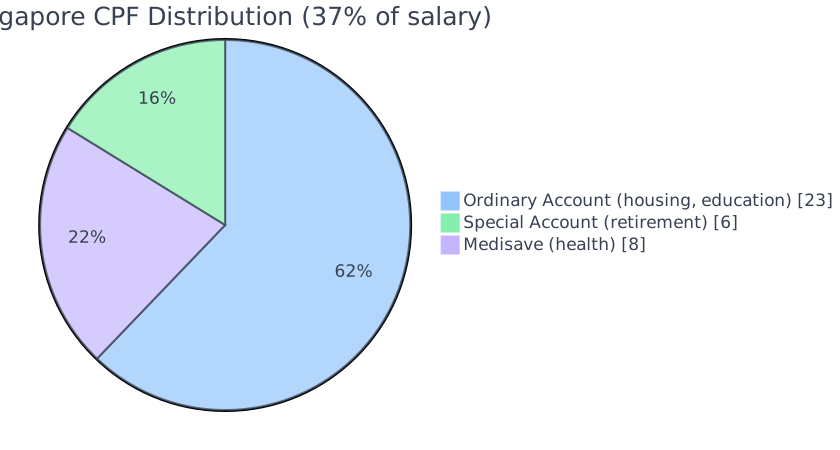
This flexibility allows using savings to buy housing (80% of Singaporeans are homeowners) while preserving retirement.
No implicit debt. The Singaporean government has no hidden pension debt. Each obligation is fully provisioned. This is the opposite of France where the implicit pension debt represents about 300% of GDP.
Macroeconomic discipline. The CPF’s forced savings (37% of salary, 20% employee + 17% employer) financed Singapore’s industrialization in the 1960s-1980s. Accumulated capital is reinvested locally.
What poses problems
Very high contribution rate. 37% of gross salary is deducted—more than in France. The difference: the money belongs to the contributor; it is not redistributed. But the burden on labor costs remains heavy.
Insufficient return for low wages. With 2.5-4% guaranteed return, very low wages don’t accumulate enough for a decent retirement. The government had to create supplements (Silver Support Scheme) [126].
Reduced flexibility at retirement. The CPF imposes a minimum “Retirement Sum” locked until 65, then converted to a life annuity. Singaporeans cannot freely dispose of their savings at retirement.
Dependence on government. The CPF is managed by a government agency, not by competing private funds. Political risk exists: a future government could change the rules.
What we keep from the Singaporean model
- The principle of individual capitalization: the money belongs to the contributor
- Multi-use flexibility: retirement, health, housing in the same vehicle
- Absence of implicit debt: everything is provisioned
- Macroeconomic discipline: forced savings finance investment
What we improve
- Competition between funds: our system allows choice between private funds, not a state monopoly
- Explicit opt-out: the freedom not to contribute (with assumed consequences)
- Autonomous community safety net: those without enough are not abandoned, they join a productive community
- Market rate of return: no artificial guarantee that can mask risks
What we don’t adopt
- State monopoly: management must be private and competitive
- Fixed contribution rate: our system allows more flexibility
- Mandatory life annuity: the contributor decides how to use their savings at retirement
7.10 — Case study (empirical example) #4: The Dutch system (2006-present)
The Netherlands has reformed its pension system to combine minimal pay-as-you-go and massive capitalization via professional pension funds [127]. With 1,800 billion euros in assets (180% of GDP), it’s the most capitalized system in Europe.
What worked
Massive capitalization. Dutch pension funds manage 180% of GDP in assets [127]. Each worker accumulates rights proportional to their contributions and returns.
Social partnership. Funds are managed jointly by unions and employers, sector by sector. This shared governance has ensured the system’s political stability.
Very limited pay-as-you-go. The AOW (universal basic pension) represents only 50% of final salary for a single person. The rest comes from capitalization. The intergenerational burden is minimized.
Transparency. Every Dutch person can consult their “pensioenoverzicht” detailing their accumulated rights in each fund.
What poses problems
Underfunding crisis. Low rates since 2008 have put defined-benefit funds in difficulty. Several have had to reduce promised pensions [127].
Complexity. The system mixes public pension, professional funds, and individual savings. Three pillars, three logics, three administrations.
Sectoral rigidity. A worker changing sectors sometimes must change funds, with complex transfer rules.
What we keep from the Dutch model
- The dominance of capitalization over pay-as-you-go
- Transparency of accumulated rights
- Discipline of professional pension funds
What we improve
- Total portability: the account follows the worker, not the sector
- No pay-as-you-go at all: our system is 100% capitalization
- Simplicity: one pillar, not three