VI — Money
Chapitre VI
MONEY: THE END OF MONOPOLY
The State has a secret weapon to circumvent budget constraints: the printing press. Cannot raise taxes? Print. Cannot cut spending? Print. The inflation that follows is an invisible, unvoted tax that hits the poorest first—those with no assets to protect themselves.
The solution is not to forbid the State from managing a currency. It is to subject it to competition.
6.1 — Currency Competition
Gold, Bitcoin, private currencies, regional or even foreign currencies, are authorized in all transactions. Everyone can choose their currency. The State continues to issue its own, but it no longer has a monopoly.
Specifications govern private currencies to prevent abuse: reserve transparency, mandatory audits, user protection. And above all: all transactions, whatever currency used, remain subject to tax. Changing currency does not allow evading one’s contribution. Transactions with the State (taxes, fines, public contracts) are in national currency—giving it a natural competitive advantage against foreign currencies.
What happens then? If the State devalues its currency through inflation, citizens flee it. They turn to more stable currencies. The State is punished automatically, without any body needing to intervene. The market disciplines. This mechanism rests on a simple idea: prices aggregate dispersed knowledge that no planner can centralize [11]. When citizens flee a currency, they vote with their feet—what Hirschman calls exit [12], the most direct form of sanction.
6.2 — Stability as Competitive Advantage
In this context, the State has every incentive to maintain a stable currency. This is its advantage against Bitcoin (volatile) or gold (impractical daily). A stable national currency, backed by constitutional budget discipline, becomes attractive.
The State no longer needs to print to “lubricate” the economy. Stability itself becomes the lubricant. Trust replaces manipulation.
6.3 — Adjustment Through Reduction, Not Inflation
In case of crisis, if the budget cushion is insufficient, we cut spending. We do not create money. Reduction is painful but fast. The economy adjusts and recovers. There are no inflationary aftereffects, no accumulated debt, no crisis artificially prolonged. Inflation modifies agents’ expectations [90]: once established, it self-perpetuates, because everyone adjusts their behavior in anticipation of the next rise.
This is the lesson of the Austrian school, confirmed by the Milei experience in Argentina.
6.4 — Case Study (Empirical Example) #1: Ecuadorian Dollarization (2000)
Ecuador adopted the US dollar as its official currency in January 2000, after a catastrophic monetary crisis [91][92]. The sucre had lost 67% of its value in one year. Inflation reached 96%. Banks were collapsing.
What Worked
End of hyperinflation. Inflation dropped from 96% (2000) to 2-3% by 2004 [92]. Price stability became the norm. Savers stopped fleeing to real assets.
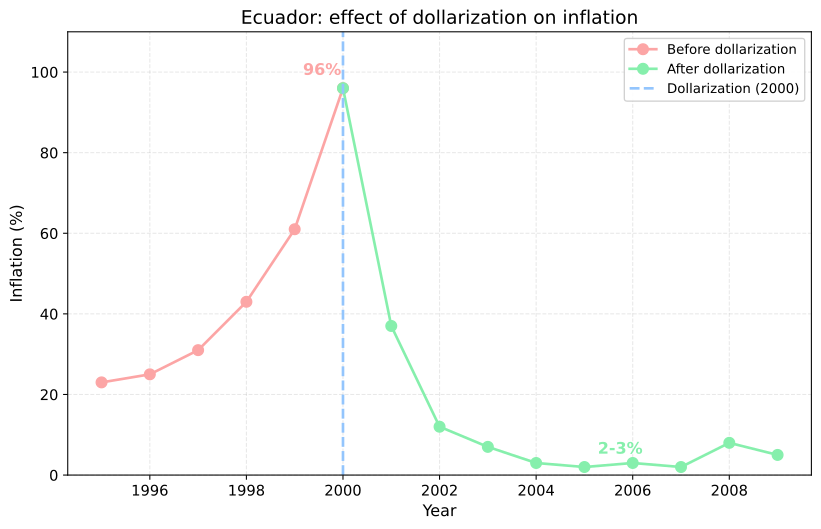 Figure 6.1 — Ecuador: effect of dollarization on inflation
Imported credibility. By abandoning its currency, Ecuador “borrowed” the Federal Reserve’s credibility. Interest rates dropped. Foreign investment stabilized.
Forced budget discipline. Without the printing press, the government can no longer monetize its deficits. It must balance or borrow on markets—at rates that punish irresponsibility.
Durability. 25 years later, despite left-wing (Correa) and right-wing governments, no one has reintroduced a national currency. Popular consensus remains strong.
What Is Problematic
Loss of monetary policy. Ecuador cannot devalue to absorb an external shock (oil price drop, for example). Adjustment goes entirely through wages and employment [93].
Dollar dependence. Fed decisions are made for the American economy, not Ecuador’s. A US rate hike can strangle the local economy.
No lender of last resort. In case of banking crisis, the State cannot create money to bail out. Systemic risk remains [92].
Excessive rigidity? Some economists consider the system too rigid, depriving the country of macroeconomic adjustment tools [93].
What We Keep from the Ecuadorian Model
- Discipline through impossibility of monetization: when you cannot print, you manage
- Price stability as a public good acquired by abandoning monetary monopoly
- Proof of political durability: 25 years without reversal
What We Improve
- Competition rather than abandonment: our system maintains a national currency, but in competition with others. The State keeps a monetary policy tool, but disciplined by the market
- No dependence on a foreign central bank: the diversity of accepted currencies avoids dependence on a single authority
- Preserved flexibility: the State can adjust its policy, but citizens vote with their feet (and wallets)
What We Do Not Adopt
- Total abandonment of monetary sovereignty: we keep a national currency
- Dependence on a single foreign issuer: competition implies several alternatives
- Absence of lender of last resort: private insurance and risk compartmentalization replace this role
6.5 — Case Study (Empirical Example) #2: The Israeli Stabilization Plan (1985)
Israel offers a fascinating counter-example: how to stop hyperinflation without abandoning one’s currency [94][95]. In 1984, inflation reached 450% per year. The country was on the brink of economic collapse.
What Worked
Credibility shock. The plan combined temporary price and wage freeze, drastic deficit reduction (from 15% to 1% of GDP), and shekel anchor to the dollar [94]. Inflation fell to 20% in one year, then to single digits in following years.
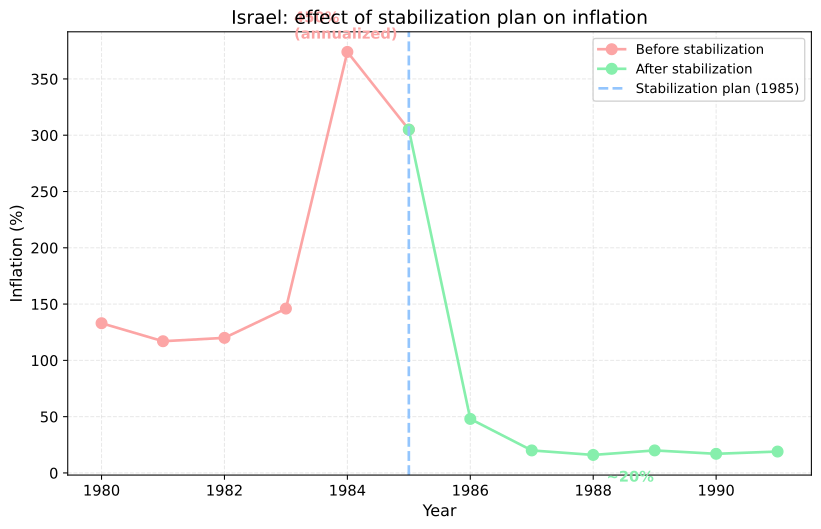 Figure 6.2 — Israel: effect of the stabilization plan on inflation
Simultaneous structural reforms. The freeze was not an end in itself, but a pause to allow real adjustments: subsidy cuts, privatizations, gradual liberalization [95].
Government-union-employer coordination. The temporary “social pact” allowed absorbing the shock without social explosion. Each party accepted immediate sacrifices for collective gain.
Maintained monetary sovereignty. Unlike Ecuador, Israel kept its currency and central bank. Discipline came from policy, not tool abandonment.
What Is Problematic
The price freeze is not libertarian. Temporarily controlling prices violates free market principles. It was an emergency measure, not a permanent model.
Dependence on political will. The plan worked because the national unity government wanted it. Without this rare consensus, it would have failed. “Political culture” is not exportable [95].
Massive external aid. The United States provided $1.5 billion in emergency aid. Not all countries have such a generous ally.
Possible relapses. Without a permanent constitutional mechanism, the risk of inflation return exists. Discipline remains political, therefore fragile.
What We Keep from the Israeli Model
- Proof that one can stabilize without abandoning one’s currency
- The importance of structural reforms accompanying stabilization
- The principle of credible shock rather than gradual adjustment
What We Improve
- Permanent automatic mechanism: our system inscribes discipline in the constitution, not in a government’s will
- Monetary competition: discipline comes from the market (flight to other currencies), not from administrative freeze
- No price controls: price freedom is preserved even in crisis
What We Do Not Adopt
- Price and wage freeze: incompatible with libertarian principles
- Dependence on exceptional political consensus: our system works with ordinary politicians
- Need for massive external aid: the system must be self-sufficient