V — The state
Chapitre V
THE STATE: PERIMETER AND FINANCES
Let’s start at the beginning: what is the State for?
5.1 — The sovereign functions – the reactor core
Justice. Police. Army. Diplomacy. These functions involve the legitimate use of force. Privatize them, and you get competing militias, à la carte justice, fragmented allegiances. The State holds the monopoly on legitimate violence. That’s its primary reason for being, its DNA.
5.2 — Emergency services – private management, public control
Firefighters and emergency medical services sit at the border of sovereign functions. They protect life, but their management does not require a State monopoly.
How does it work? Firefighters are delegated to private companies, chosen by competitive bidding at the municipal or inter-municipal level. Municipalities can group together to strengthen their bargaining power – economies of scale, intensified competition. Contracts are time-limited, with strict specifications: maximum response time, mandatory equipment, staff training. Emergency medical services work the same way, but at a larger scale – departmental or regional – because helicopters and mobile intensive care units require critical mass.
The principle: the private manages, the public controls, competition disciplines. If a provider fails, it loses the contract. The market sanctions incompetence faster than bureaucracy.
5.3 — Fundamental research – betting on the next century
Physics. Astronomy. Chemistry. Nuclear fusion. These fields have one thing in common: their return on investment is counted in decades, sometimes centuries. What private investor would finance research today whose benefits will arrive in a hundred years? None. And yet, all civilization benefits from it. The Internet, GPS, nuclear energy, semiconductors – all this comes from fundamental research that the market would never have funded.
Concrete examples: black hole studies, gravitational waves, unification of the four fundamental forces, nuclear fusion reactors (ITER), large synchrotrons (CERN), pure mathematical research, fundamental biological research.
The criterion is clear: if the return on investment exceeds the private sector’s time horizon, and if the benefit is collective, then public funding is justified.
But always through competitive bidding. Labs, universities, consortia in competition. No rents: each project must be defended, evaluated, renewed. Peer review (independent scientific committees) takes precedence over price considerations.
The obligation of local spin-offs. All public research funding – including through international consortia – must generate local spin-offs: jobs, skills, patents, infrastructure. No blank check to foreign entities. This obligation is constitutionalized.
International consortia (CERN, ITER, ESA…) are pooling of resources, not funding of foreign entities. Each country funds its share and receives its share of spin-offs. If a consortium does not respect this rule: we renegotiate, we seek an amicable agreement, we sue if necessary, and we exit – but only after recovering what is owed.
If no acceptable offer is received, several possible reasons:
- The country lacks competence: we drop it, or we redefine the tender to create local competence (training, transfer, capacity building).
- It’s already covered by the private sector: the market already funds this field; the public tender is unnecessary. Good news.
- It’s not interesting: scientists themselves don’t want to invest in it. Signal: bad idea, we move on.
Public money funds national competence, not dependence on foreign entities.
Strategic investment. Beyond fundamental research, the State can invest in industries to develop: semiconductors, batteries, biotech, AI, space, etc. This is an industrial bet. Same rules: competitive bidding, local spin-offs, budgetary envelope.
Prestige as investment. National prestige is a legitimate return on investment, as long as it remains reasonable:
- Attracts talent (researchers, students, entrepreneurs)
- Strengthens the country’s image (soft power)
- Creates national pride
The spillover effect. Even “inapplicable” research pulls an entire field upward. Those who can do the most can do the least:
- A space program advances all engineering
- Particle physics stimulates instrumentation, computing, materials
- Pure mathematics always ends up finding applications (cryptography, AI, finance…)
- Training teams on the very difficult makes them excellent at the rest
We never know what will be useful in 50 years. Radio waves were a laboratory curiosity before Marconi. Quantum mechanics seemed purely theoretical before transistors. Funding today’s “useless” is preparing tomorrow’s useful.
The safeguard: the constitutional budgetary envelope limits excesses. We can’t fund everything. We must prioritize. But prestige and spillover effects are legitimate criteria in this prioritization.
5.4 — Competitive bidding: not just price
This principle applies to all public tenders, not just research.
If price is the only criterion, you get the lowest bidder, not the best bidder. Result: mediocrity, cut corners, failures. This is “mediocritization.”
Mandatory multiple criteria (constitutionalized):
- Price: 30-40% maximum
- Technical quality: 30-40%
- Track record (past results): 15-20%
- Deadlines / feasibility: 10-15%
The exact weighting may vary according to the type of tender (research, construction, services), but price can never be the sole or majority criterion.
For fundamental research specifically: peer review, team track record, originality and discovery potential. Price is secondary – we fund the best science, not the cheapest.
5.5 — Total transparency of public procurement
All tenders are published. No exceptions. Specifications, evaluation criteria, weighting – everything is public from the launch.
All bids are published together after the submission deadline. Once the deadline has passed, all received bids are made public simultaneously. Every citizen can see who proposed what, at what price, with what conditions. Light kills fraud.
Jury deliberations are public. How each bid was scored on each criterion, why a candidate was selected or rejected – everything is documented and accessible.
The final contract is public. Including subsequent amendments. A contract that inflates after signing is visible.
5.6 — Referendum for large contracts
Above a certain threshold – for example 5% of the concerned authority’s annual budget – the contract must be approved by referendum. The people decide whether they want to commit a significant share of their money to this project.
The mechanism:
- The authority publishes the tender, receives bids, evaluates them, selects a winner
- The choice is submitted to referendum with the complete file: project, selected bid, justification of choice, rejected alternatives
- The referendum is held by property-weighted voting (it’s a budgetary question – those who pay decide)
- If the referendum rejects, the authority can relaunch a new tender with modified specifications, or abandon the project
The threshold is relative to the authority. For a municipality, 5% of the budget may represent a few million. For the State, it would be billions. Popular control is exercised at each level, proportionally to the stakes.
Popular control prevents fraud. When everyone is watching, backroom deals become risky. Overcharging is visible. Specifications tailored for a favored candidate are detected. Transparency + referendum = double insurance against corruption.
5.7 — Extreme cases – leaving no one on the roadside
The insurance market works on risk mutualization. But some cases are so costly that no private insurer will voluntarily take them. Heavy chronic diseases. Profound disabilities. Specialized education. Without intervention, these people are abandoned.
Caution: this does not mean the State should manage these cases directly. All non-sovereign public funding must first go through competitive bidding to the private sector. The State only funds the supplement if necessary, or reschedules the project. The private manages, the State supplements. No one is abandoned, but the State manages nothing directly.
An independent anti-cartel authority ensures these tenders remain competitive. It has investigative and sanctioning powers. All contracts are public.
5.8 — And nothing else
Everything else – standard education, routine healthcare, pensions, unemployment, transport, energy, housing – can and must be managed by the private sector, with if necessary a mandatory insurance obligation. The State does not have to produce these services. It simply must ensure no one falls through the cracks.
5.9 — No indirect funding either
The State does not fund NGOs, associations, culture, sports, or any other non-sovereign sector. Neither directly by subsidy, nor indirectly by tax reduction. Tax niches are disguised expenditures – they bypass the budgetary ceiling and escape democratic control.
If citizens want to support a cause, they do it with their own money, not the taxpayer’s. Private generosity replaces State redistribution. It’s more efficient – everyone chooses what they fund – and more honest – no clientelism.
5.10 — The constitutional safe
The State must fund certain things. Fine. But how to prevent it from always funding more? This is THE problem of liberalism for two centuries. Each legitimate exception becomes a precedent. The perimeter inexorably expands, like an oil stain.
The answer is in one word: constitution. Not a constitution of vague principles and fine declarations, but a constitution of strict rules, locked by a quasi-impossible majority to reach.
5.11 — Rule #1: Mandatory budgetary surplus
The State must not only balance its budget. It must generate a surplus each year. This surplus feeds the structural reserve fund – a cushion for future storms. When crisis arrives, we draw from the cushion. We don’t borrow. We don’t print. We don’t push the problem onto future generations.
Use of the cushion is regulated. When drawing from the reserve fund, a temporary and concomitant spending reduction is imposed – for example 50% of the shock absorbed by the reserve fund, 50% by spending reduction. This ratio is constitutionalized. The objective: extend the cushion’s effect, be able to absorb a second shock if the first is prolonged, and force real-time adjustment.
If the cushion is insufficient despite this discipline, we reduce spending further. It’s painful, but it’s short. Brutal adjustment allows rapid recovery. Chronic deficit prolongs the agony.
Budgetary slippage below threshold triggers elections. The constitutional minimum surplus threshold is for example 5%. If the government projected an effort of 8% and achieves only 6%, there’s no problem – we remain above threshold. On the other hand, if the surplus falls below 5% (outside legitimate crisis), parliamentary elections are automatically triggered. It’s the principle of credible commitment [70]: a quasi-inviolable rule changes incentives better than a political promise — because violating it is costly.
How to distinguish slippage from legitimate crisis? The criterion used is real GDP: if GDP falls by more than X% compared to the previous year (for example 2%), it’s a crisis – passing below threshold is tolerated without automatic elections. If GDP is stable or growing and the budget slips below threshold, it’s irresponsibility – automatic elections.
The recall mechanism as safety net. Even without automatic elections, the permanent recall system allows citizens to trigger new elections if they judge budgetary management unacceptable. It’s not automatic, but it’s in their hands.
Capping the reserve fund. The structural reserve fund cannot grow indefinitely. A ceiling is set as a percentage of GDP (for example 50% or 100% — to be calibrated). Beyond that, the surplus no longer feeds the fund.
When the ceiling is reached, Parliament decides on surplus allocation: sovereign investments, infrastructure, army, fundamental research. It’s an ordinary budgetary decision, not a constitutional revision.
The buffer year. What is not spent in year N is automatically deducted from year N+1 levies. The State cannot hoard: unused money returns to taxpayers. This mechanism is automatic — it requires no vote.
Priority allocation during pension transition. During the pension system transition period (see appendix E), the budgetary surplus is prioritized for repaying the transition debt — the temporary loan covering the gap between pension needs and the constitutional differential ceiling. This priority is inscribed in the constitution. It guarantees that transition debt remains minimal (close to zero) and that the transition ends without burdening future generations. Once the transition is complete, the surplus returns to its normal allocation (structural reserve fund).
A second fund exists: the catch-up fund. It’s fed by involuntary “savings” in case of budgetary blockage (we’ll come back to this). This money is earmarked to repair blockage damage – aging infrastructure, deferred maintenance. Same logic: if the fund is not fully used, the surplus is deducted from next year’s taxes. We don’t mix prudence (structural reserve fund) with consequences of irresponsibility (catch-up fund).
5.12 — Rule #2: Strict ceiling on levies
All mandatory levies – taxes, fees, contributions, charges, whatever the name – cannot exceed a certain percentage of GDP. This ceiling is inscribed in the constitution.
The definition must be extensive. All money transiting through the State or its emanations, whatever the legal appellation, counts toward the ceiling. This closes the door to semantic games: renaming a tax as “contribution” changes nothing. Any quantified rule generates circumvention strategies — this is Goodhart’s law [71]: when a measure becomes a target, it ceases to be a good measure. Hence the extensive definition.
Where to set the ceiling? International examples.
International comparison shows that very different levels of public spending are possible, with measurable results:
| Country | Public spending (% GDP) | HDI | Life expectancy | Crime |
|---|---|---|---|---|
| Singapore | 17% | 0.939 (9th worldwide) | 84 years | Very low |
| Hong Kong (pre-2020) | 20% | 0.952 (4th) | 85 years | Low |
| Switzerland | 34% | 0.962 (1st) | 84 years | Very low |
| United States | 38% | 0.921 (20th) | 77 years | High |
| France | 56.5% | 0.903 (28th) | 82 years | Medium |
| Denmark | 52% | 0.952 (6th) | 81 years | Low |
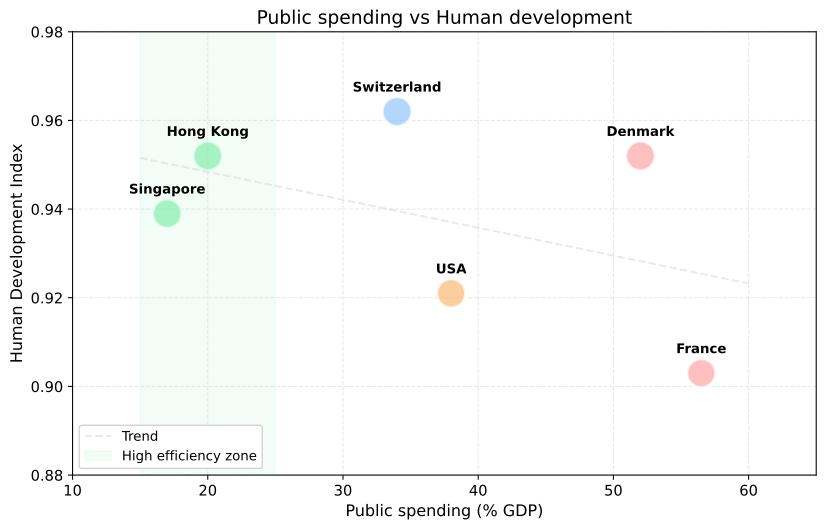
What this data shows:
Singapore and Hong Kong prove that a State at 17-20% of GDP can produce excellent social outcomes: life expectancy among the highest in the world, near-zero crime, top-tier education, impeccable infrastructure. These results are not achieved despite low spending, but thanks to the efficiency forced by budgetary constraints.
France, with 56.5% of GDP in public spending (world record among major economies), achieves an HDI lower than Singapore’s and comparable life expectancy. Tripling spending does not triple results.
Switzerland achieves the world’s best HDI with 34% of GDP — 22 points less than France. The difference is decentralization and budgetary discipline.
The Singapore model: what works?
Singapore funds its essential public services (education, health, security) with only 17% of GDP thanks to several mechanisms:
No pay-as-you-go pensions: the Central Provident Fund (CPF) is a mandatory capitalization system where each worker saves for their own retirement. No intergenerational transfer, no implicit debt.
Systematic copayment: in health and education, the citizen pays part of the cost. This eliminates overconsumption and creates responsibility.
Social housing through ownership: 80% of Singaporeans live in HDB housing they own, not rent. The State builds and sells; it does not subsidize perpetually.
Absence of massive redistribution: no generous unemployment benefits, no comfortable minimum income. Solidarity comes through family and community, not the State.
This model is not perfect: democratic participation is weak, freedom of expression limited, the ruling party is quasi-hegemonic. This document borrows Singapore’s budgetary efficiency, not its political authoritarianism.
5.13 — Rule #3: Prohibition on delegating sovereign functions by obligation
The State cannot bypass the ceiling by requiring businesses to fund public missions. If an obligation economically amounts to a tax, it must be counted as such. No sleight of hand.
5.14 — Rule #4: The four-fifths lock
These rules can only be modified with a four-fifths (or three-quarters) majority of each chamber (Parliament AND Senate, separately). This is virtually unattainable in practice. No normal political coalition can gather such consensus in both chambers simultaneously. Rules become virtually inviolable, except by broad consensus.
5.15 — Case study (empirical example): The Swiss debt brake (Schuldenbremse)
Switzerland adopted in 2001, by referendum (85% yes), a constitutional mechanism of budgetary discipline known as the “debt brake” [72][73]. This mechanism offers a valuable empirical precedent for evaluating the feasibility of rules proposed in this chapter.
What worked
Spectacular debt reduction. Between 2003 and 2023, the Confederation’s gross debt fell from 130 billion CHF to less than 85 billion CHF, from 25% to about 12% of GDP [74]. This is exceptional performance among developed economies.
Counter-cyclical discipline. The mechanism requires that spending not exceed cycle-adjusted revenues. In growth periods, surplus is mandatory. In recession, a limited deficit is tolerated. The cyclical factor (ratio between potential and actual GDP) disciplines automatically [72].
Strong democratic legitimacy. Approved by popular referendum, the mechanism enjoys rare citizen acceptance. Political attempts to bypass it are unpopular.
Regulated flexibility. A compensation account absorbs temporary gaps between forecasts and outcomes. Overruns must be absorbed within the following six years [73].
What poses problems
Loophole through para-state entities. The rule only applies to the Confederation. Cantons, municipalities, and entities like railways or postal services can borrow without federal constraint. The rule’s “perimeter” leaves blind spots [75].
Circumvention through extraordinary spending. Since 2020, Covid-19 was classified as “extraordinary spending” outside the brake. Debt temporarily climbed. The repayment mechanism exists, but political temptation to extend the exception remains [74].
No automatic sanction. If Parliament votes a non-compliant budget, there is no automatic dissolution. The Court of Auditors signals, but does not impose. The system relies on Swiss political culture, difficult to export.
Potential underinvestment. Some economists criticize a bias toward excessive austerity, to the detriment of long-term infrastructure [75]. The debate remains open.
What we keep from the Swiss model
- The constitutional principle of balanced or surplus budget
- The compensation account to absorb temporary fluctuations
- Legitimization by referendum of fundamental budgetary rules
- The cyclical factor that allows limited deficits in recession
What we improve
- Expanded perimeter: our system includes all levies and all public entities in the ceiling, not just the Confederation
- Automatic sanction: slippage below threshold triggers elections, not just a report
- Permanent mandatory surplus: not just balance, but a surplus that feeds the reserve fund
- Recall mechanism: citizens can sanction in real time, not just at ordinary elections
What we don’t retain
- The “extraordinary spending” exception: our system uses the objective criterion of real GDP (drop > X%) to qualify a crisis. No discretionary political qualification
- No constraint on lower levels: all levels count in the global ceiling
- Trust in political culture: our system relies on automatic mechanisms, not on the goodwill of elected officials