E — Pension transition
Appendice E
PENSION TRANSITION — FROM PAY-AS-YOU-GO TO CAPITALIZATION
Reference: Chapter VII (Protection Without the Welfare State)
E.1 — Why Pay-as-You-Go is Rejected
The pay-as-you-go pension system — where contributions from active workers finance current retirees’ pensions — suffers from irreparable structural flaws.
A pyramid-like system. Pay-as-you-go only works if each generation is larger (or wealthier) than the previous one. It’s mathematically identical to a Ponzi scheme: the last arrivals pay for the first. When demographic growth reverses, the system collapses.
Enslavement of future generations. Children did not choose to be born. Yet, as soon as they work, they are forced to contribute to pay their elders’ pensions. This is not solidarity — it’s an obligation imposed without consent. Capitalization, on the other hand, liberates each generation: everyone saves for themselves.
A colossal implicit debt. Pay-as-you-go systems have accumulated unfunded pension promises. This “implicit debt” typically represents 200 to 300% of GDP — far more than the official public debt. It’s a time bomb that no one dares to face.
Intergenerational conflict. When the active/retiree ratio drops from 4:1 to 2:1 (currently underway in all developed countries), either pensions must be reduced or contributions increased. In both cases, one generation pays for the mistakes of previous ones. Capitalization avoids this conflict: everyone recovers what they saved.
Note: Two recent studies by Fondapol address the question of capitalization in the French pension system. The first [69] analyzes the advantages of capitalization as a lever to escape the demographic and financial impasse. The second [68] proposes concrete procedures for transitioning to a mixed system with 25% capitalization. These works make a serious contribution to the debate by showing that an evolution toward capitalization is technically feasible. However, they raise a fundamental question: a system maintaining 75% pay-as-you-go retains the structural burden on active workers and does not fully resolve the long-term intergenerational problem. The solution presented below is more radical: it aims for the complete extinction of pay-as-you-go, with a documented transition trajectory.
E.2 — The Transition Mechanism
Transitioning from pay-as-you-go to capitalization is technically feasible. Here’s how.
The central problem. Current retirees have acquired rights in the old system. They contributed all their lives with the promise of a pension. We cannot abandon them. But if active workers now contribute to their own capitalization, who pays current retirees’ pensions?
The solution: the temporary differential. During the transition, a temporary tax (the “differential”) finances pensions for retirees of the old system. This differential:
- Starts at approximately 10-11% of GDP
- Decreases progressively over 40 years
- Reaches 0% when all retirees from the old system have deceased
New workers capitalize. From day 1 of the transition, new entrants to the labor market contribute to their own retirement through capitalization. They owe nothing to anyone.
Mid-career workers. Those who have already contributed to the old system retain proportional rights. A worker with 20 years of career has 50% rights in the old system (paid by the differential) and capitalizes for the remaining 50%.
Progressive extinction. Year after year, retirees from the old system pass away. New retirees have fewer and fewer rights in the old system. The differential decreases mechanically until it disappears.
E.3 — The Constitutional Framework for Financing
The transition financing rests on two complementary mechanisms, both enshrined in the constitution:
The Differential: A Strict Constitutional Trajectory
The differential follows an inviolable constitutional ceiling. Its decrease (from 10% to 0% over 40 years) is fixed in advance and cannot be modified for economic reasons. It’s a normative rule, not an indicative target.
Why this rigidity?
- Predictability. Economic actors (companies, households) can plan over 40 years. No bad surprises.
- Impossibility of political manipulation. No government can extend the differential to finance something else. The temptation is eliminated at the source.
- Intergenerational trust. Young workers know exactly when the differential will disappear. They won’t pay indefinitely for previous generations’ mistakes.
Logical consequence: the differential may be insufficient. Some years, the flow of pensions to be paid exceeds the differential ceiling. This is predictable and expected. The difference is covered by temporary borrowing: the transition debt.
The Minimum Budget Surplus: The Relay Mechanism
This document imposes a constitutional minimum budget surplus (see chapter V). This surplus, set for example at 2% of GDP, plays a crucial role in the pension transition.
Priority allocation of the surplus during transition:
- Repayment of transition debt — The surplus is primarily allocated to repaying the transition debt, as long as it exists.
- Funding the reserve fund — Once the transition debt is settled, the surplus returns to its normal function.
The handoff. When the differential reaches 0% (year 40), there potentially remains residual transition debt and residual pension flows to finance. The budget surplus then takes over:
- It covers remaining pension flows (which naturally decrease with the extinction of the last retirees from the old system)
- It repays the accumulated transition debt
This mechanism guarantees that the transition completes without leaving a burden, even after the end of the differential.
Why the Transition Debt Must Remain Minimal
It’s not debt like any other. The transition debt is not borrowing to finance current expenses or investments. It’s a temporary accounting mechanism to smooth the financing of acquired rights.
Minimizing the transition debt is crucial for three reasons:
Traceability. Low debt is easy to track and explain. High debt muddies the accounts and opens the door to manipulation.
Interest costs. All debt generates interest. The lower the transition debt, the less interest we pay, the faster we exit.
Market confidence. Controlled transition debt (close to zero thanks to the budget surplus) reassures investors. It doesn’t add to public debt in an alarming way.
Result in the simulation. Thanks to the minimum budget surplus of 2% of GDP (approximately €17 billion the first year, growing with GDP), the transition debt remains virtually zero throughout the transition. Temporary loans are repaid the same year or the following year.
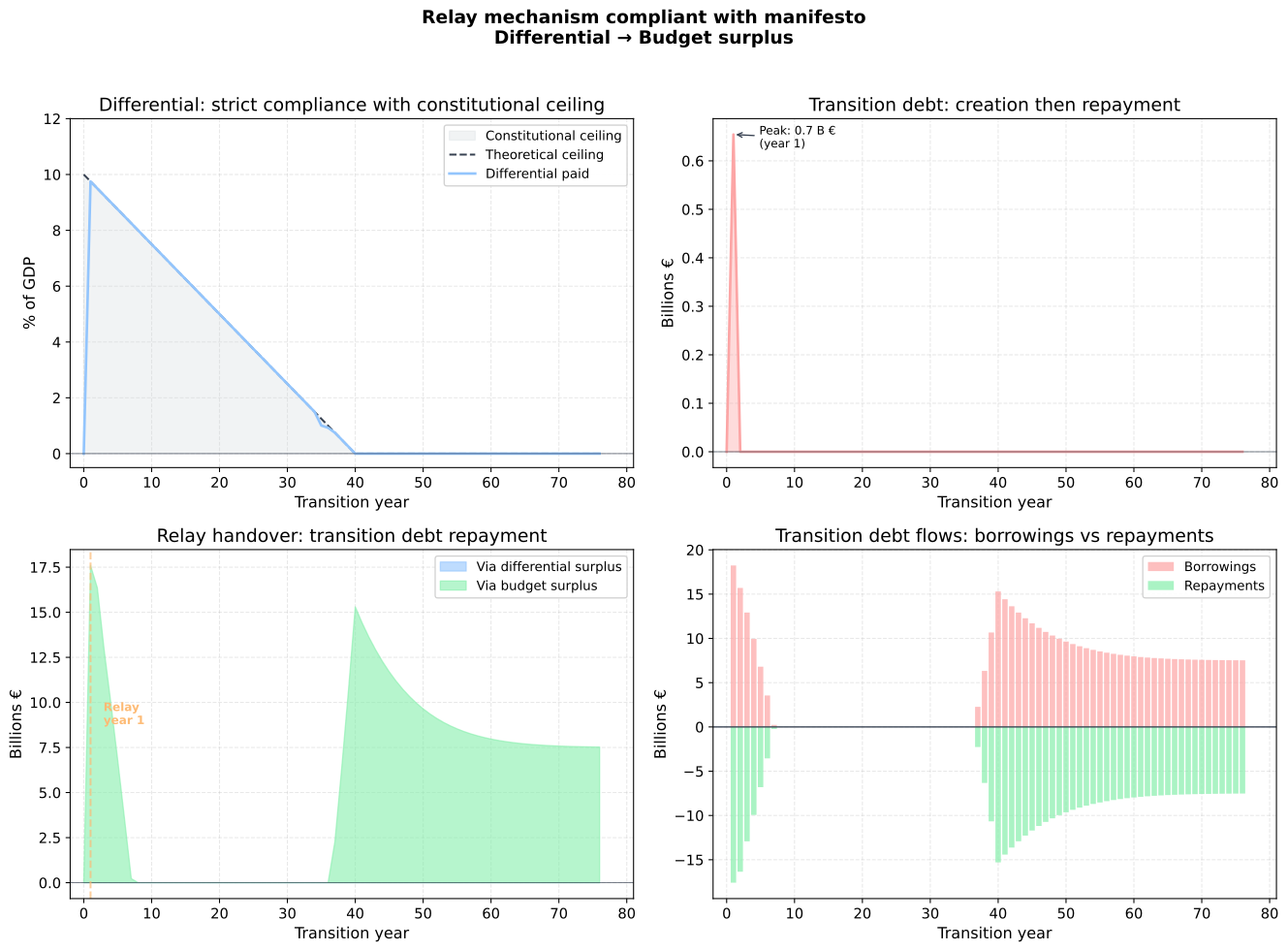 Figure E.1 — Relay mechanism between differential and budget surplus
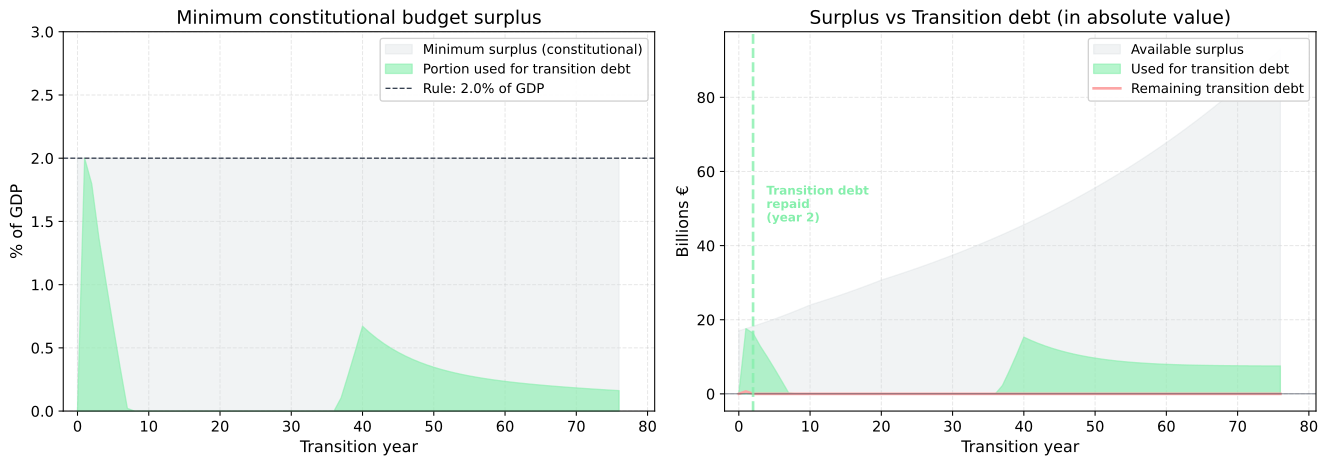 Figure E.2 — Minimum budget surplus and its use for transition debt
Configurable Constitutional Parameters
The following parameters are enshrined in the constitution and modifiable only by a four-fifths majority of each chamber:
| Parameter | Default Value | Description |
|---|---|---|
differentiel_initial | 10% of GDP | Initial differential ceiling |
duree_decroissance_differentiel | 40 years | Duration of decrease to 0 |
methode_differentiel | linear | Decrease profile |
surplus_budgetaire_minimal_pct_pib | 2% of GDP | Minimum constitutional surplus |
surplus_max_pour_dette_transition_pct | 100% | Share of surplus allocable to transition debt |
These parameters are transparent, traceable, and falsifiable. The simulator allows verification of their impact year by year.
E.4 — Simulation Results
A simulator modeled this transition for several European countries. Here are the results.
Essential point: The simulation demonstrates that the transition eliminates simultaneously both debts:
- The nominal public debt (104% of GDP for Belgium) — fully repaid
- The implicit pension debt (222% of GDP) — the pay-as-you-go system is entirely settled
The model proves that it’s possible to do both during the transition period, without leaving a burden for future generations.
Transition Duration
| Country | Total Duration | Comment |
|---|---|---|
| Poland | 72 years | More favorable demographics |
| Netherlands | 76 years | Existing mixed system helps |
| Belgium | 77 years | Reference scenario |
| France | 82 years | High implicit debt |
| Germany | 83 years | Advanced aging |
| Spain | 84 years | Structural unemployment |
| Italy | 151 years | Requires additional adjustments |
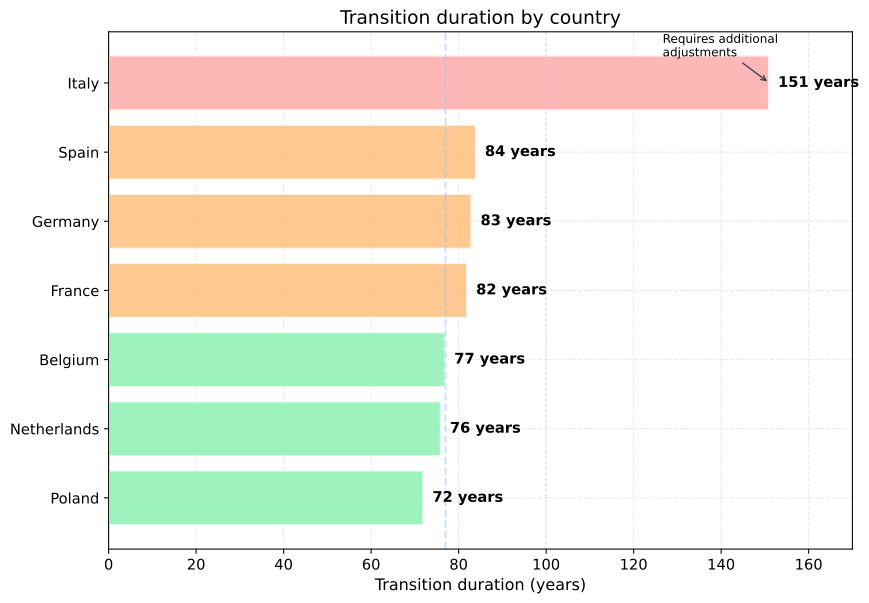 Figure E.3 — Transition duration by country
Conclusion: The transition takes 2 to 3 generations, except in extreme cases.
Transition Effort (Differential)
- Maximum: 8-11% of GDP depending on country
- Decrease duration: 40 years
- Method: Linear or progressive
This effort is comparable to current pension levies. The difference: it’s temporary and decreasing.
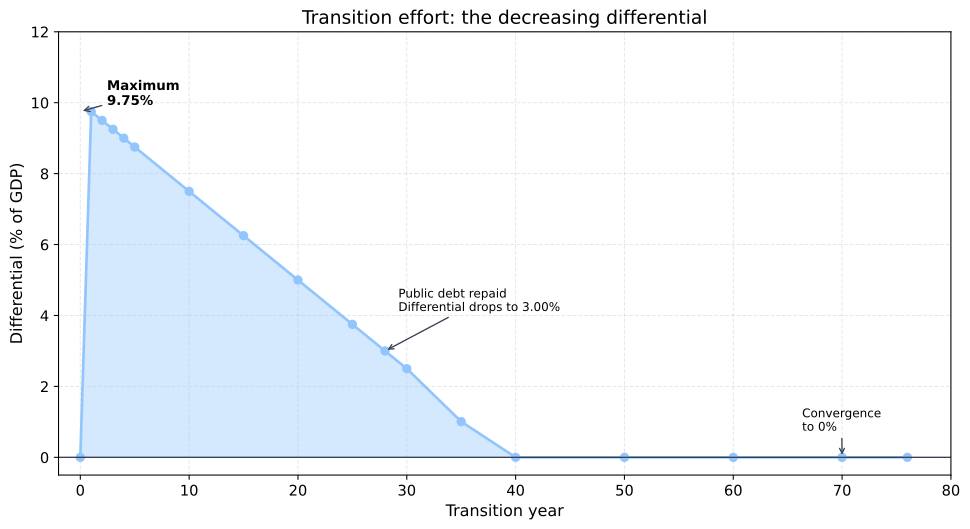 Figure E.4 — Transition effort: the decreasing differential
Debt Evolution — Complete Table (Belgium)
The table below shows the year-by-year evolution of the transition. It clearly shows how both debts converge to zero: public debt (repaid in 28 years) and implicit pension debt (settled in 76 years).
Note on debt reduction in year 1: The sharp drop in public debt between year 0 (104%) and year 1 (79%) is explained by the assumption of massive sales of public assets that no longer fall under the almost exclusively sovereign role of the State in the new social contract. This notably includes:
- schools (education becomes private with school vouchers)
- ports and airports
- public companies or State participations
- certain hospitals
- possibly fire stations
- and other real estate or financial assets
These privatizations are not “selling the family silver” — they are the logical consequence of refocusing the State on its sovereign functions.
Optimistic assumption of sale in one year. The simulation assumes these assets are sold in the first year. In reality, it will probably take several years to obtain a fair price. A rushed sale would amount to fire-selling public assets. The actual timeline will depend on market conditions and investors’ absorption capacity.
Mandatory popular validation. To avoid cronyism or corruption, each significant asset sale must be validated by referendum. The transition will be an unhoped-for opportunity for those who would want to profit unduly — only direct popular control can guarantee that sales are made in the general interest and at fair price. The valuation of public assets and sale procedures are considerable stakes [107].
| Year | GDP (Bn€) | Diff. % | Public Debt % | Pension Debt % |
|---|---|---|---|---|
| 0 | 850 | 11.82 | 104.00 | 222.35 |
| 1 | 880 | 11.22 | 79.09 | 203.86 |
| 2 | 911 | 10.62 | 77.11 | 186.57 |
| 3 | 942 | 10.02 | 75.14 | 170.43 |
| 4 | 975 | 9.42 | 73.17 | 155.42 |
| 5 | 1010 | 8.84 | 71.20 | 141.48 |
| 6 | 1045 | 8.27 | 69.24 | 128.58 |
| 7 | 1081 | 8.00 | 67.28 | 116.65 |
| 8 | 1119 | 7.75 | 65.04 | 105.66 |
| 9 | 1158 | 7.50 | 62.52 | 95.54 |
| 10 | 1199 | 7.25 | 59.75 | 86.26 |
| 11 | 1229 | 7.00 | 57.41 | 78.50 |
| 12 | 1260 | 6.75 | 54.91 | 71.34 |
| 13 | 1291 | 6.50 | 52.27 | 64.72 |
| 14 | 1323 | 6.25 | 49.50 | 58.62 |
| 15 | 1357 | 6.00 | 46.64 | 53.01 |
| 16 | 1390 | 5.75 | 43.70 | 47.86 |
| 17 | 1425 | 5.50 | 40.69 | 43.14 |
| 18 | 1461 | 5.25 | 37.65 | 38.82 |
| 19 | 1497 | 5.00 | 34.59 | 34.87 |
| 20 | 1535 | 4.75 | 31.54 | 31.26 |
| 21 | 1566 | 4.50 | 28.67 | 28.12 |
| 22 | 1597 | 4.25 | 25.83 | 25.24 |
| 23 | 1629 | 4.00 | 23.05 | 22.62 |
| 24 | 1661 | 3.75 | 20.33 | 20.22 |
| 25 | 1695 | 3.50 | 17.70 | 18.05 |
| 26 | 1728 | 3.25 | 15.15 | 16.07 |
| 27 | 1763 | 3.00 | 12.71 | 14.27 |
| 28 | 1798 | 2.75 | 10.39 | 12.64 |
| 29 | 1834 | 2.50 | 8.19 | 11.18 |
| 30 | 1871 | 2.25 | 6.13 | 9.85 |
| 34 | 2025 | 1.01 | 0.00 | 5.79 |
| 40 | 2281 | 0.67 | 0.00 | 2.39 |
| 45 | 2518 | 0.46 | 0.00 | 1.08 |
| 50 | 2780 | 0.35 | 0.00 | 0.46 |
| 55 | 3069 | 0.28 | 0.00 | 0.19 |
| 60 | 3389 | 0.24 | 0.00 | 0.07 |
| 65 | 3742 | 0.21 | 0.00 | 0.02 |
| 70 | 4131 | 0.18 | 0.00 | 0.01 |
| 76 | 4652 | 0.16 | 0.00 | 0.00 |
| Tableau E.1 — Evolution of both debts during the transition (Belgium) |
Final result: Both debts are at zero. Public debt is repaid in 34 years, implicit pension debt is settled in 76 years. The country is freed from all burden.
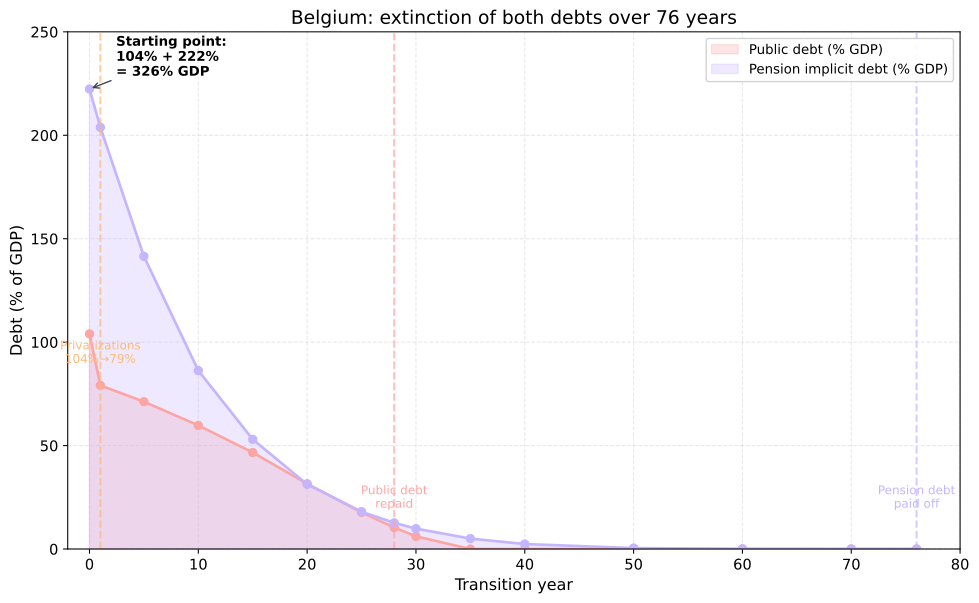 Figure E.5 — Belgium: extinction of both debts over 76 years
Impact on Salaries — Complete Table (Belgium)
The table below shows the evolution of net salary for different income levels, year by year.
This table integrates the gain from abolishing indirect taxes (VAT, excises, property taxes). These regressive taxes [81][82] weigh more heavily on low incomes — their abolition is therefore directly integrated into the net calculation. Insurance amounts are calculated tax-free [83] since taxes on insurance operations (9.25% general, 2% life insurance) are also abolished. All salaries are winners from day one. No corrective mechanism is necessary.
| Year | Diff. % | 2000€ Net | Tax % | 3000€ Net | Tax % | 4000€ Net | Tax % | 5000€ Net | Tax % | 7000€ Net | Tax % | 10000€ Net | Tax % |
|---|---|---|---|---|---|---|---|---|---|---|---|---|---|
| -1 | Current | 1100€ | 45.0% | 1650€ | 45.0% | 2200€ | 45.0% | 2750€ | 45.0% | 3850€ | 45.0% | 5500€ | 45.0% |
| 0 | 11.82 | 1350€ | 32.5% | 2036€ | 32.1% | 2701€ | 32.5% | 3371€ | 32.6% | 4679€ | 33.2% | 6668€ | 33.3% |
| 1 | 11.22 | 1362€ | 31.9% | 2054€ | 31.5% | 2725€ | 31.9% | 3401€ | 32.0% | 4721€ | 32.6% | 6728€ | 32.7% |
| 2 | 10.62 | 1374€ | 31.3% | 2072€ | 30.9% | 2749€ | 31.3% | 3431€ | 31.4% | 4763€ | 32.0% | 6788€ | 32.1% |
| 3 | 10.02 | 1386€ | 30.7% | 2090€ | 30.3% | 2773€ | 30.7% | 3462€ | 30.8% | 4805€ | 31.4% | 6848€ | 31.5% |
| 4 | 9.42 | 1398€ | 30.1% | 2108€ | 29.7% | 2797€ | 30.1% | 3491€ | 30.2% | 4847€ | 30.8% | 6908€ | 30.9% |
| 5 | 8.84 | 1409€ | 29.5% | 2126€ | 29.1% | 2820€ | 29.5% | 3520€ | 29.6% | 4888€ | 30.2% | 6966€ | 30.3% |
| 6 | 8.27 | 1421€ | 29.0% | 2143€ | 28.6% | 2843€ | 28.9% | 3549€ | 29.0% | 4928€ | 29.6% | 7023€ | 29.8% |
| 7 | 8.00 | 1426€ | 28.7% | 2151€ | 28.3% | 2854€ | 28.6% | 3562€ | 28.7% | 4946€ | 29.3% | 7050€ | 29.5% |
| 8 | 7.75 | 1431€ | 28.4% | 2158€ | 28.1% | 2864€ | 28.4% | 3575€ | 28.5% | 4964€ | 29.1% | 7075€ | 29.2% |
| 9 | 7.50 | 1436€ | 28.2% | 2166€ | 27.8% | 2874€ | 28.1% | 3588€ | 28.2% | 4982€ | 28.8% | 7100€ | 29.0% |
| 10 | 7.25 | 1441€ | 28.0% | 2174€ | 27.6% | 2884€ | 27.9% | 3600€ | 28.0% | 4999€ | 28.6% | 7125€ | 28.7% |
| 15 | 6.00 | 1466€ | 26.7% | 2211€ | 26.3% | 2934€ | 26.7% | 3662€ | 26.8% | 5086€ | 27.3% | 7250€ | 27.5% |
| 20 | 4.75 | 1491€ | 25.4% | 2248€ | 25.1% | 2984€ | 25.4% | 3725€ | 25.5% | 5174€ | 26.1% | 7375€ | 26.2% |
| 25 | 3.50 | 1516€ | 24.2% | 2286€ | 23.8% | 3034€ | 24.1% | 3788€ | 24.2% | 5262€ | 24.8% | 7500€ | 25.0% |
| 30 | 2.25 | 1541€ | 22.9% | 2324€ | 22.6% | 3084€ | 22.9% | 3850€ | 23.0% | 5349€ | 23.6% | 7625€ | 23.8% |
| 34 | 1.01 | 1566€ | 21.7% | 2361€ | 21.3% | 3134€ | 21.7% | 3912€ | 21.8% | 5436€ | 22.3% | 7749€ | 22.5% |
| 40 | 0.62 | 1574€ | 21.3% | 2372€ | 20.9% | 3149€ | 21.3% | 3932€ | 21.4% | 5463€ | 22.0% | 7788€ | 22.1% |
| 50 | 0.33 | 1579€ | 21.0% | 2381€ | 20.6% | 3161€ | 21.0% | 3946€ | 21.1% | 5483€ | 21.7% | 7817€ | 21.8% |
| 60 | 0.23 | 1581€ | 20.9% | 2384€ | 20.5% | 3165€ | 20.9% | 3951€ | 21.0% | 5491€ | 21.6% | 7827€ | 21.7% |
| 70 | 0.18 | 1582€ | 20.9% | 2386€ | 20.5% | 3167€ | 20.8% | 3954€ | 20.9% | 5494€ | 21.5% | 7832€ | 21.7% |
| 75 | 0.16 | 1583€ | 20.9% | 2386€ | 20.5% | 3168€ | 20.8% | 3954€ | 20.9% | 5495€ | 21.5% | 7834€ | 21.7% |
| Tableau E.2 — Impact on salaries during the transition (Belgium) |
Combined Effect from Year 0 (Differential + Abolition of Indirect Taxes)
Important note: The impact of the differential ALREADY includes payment for the 4 mandatory private insurances (health €73, unemployment €37, pension €59, education €46 = €215/month). These insurances replace benefits currently financed by taxation. The displayed gain is therefore NET of all charges.
| Gross Salary | Current Net | New System Impact* | Indirect Tax Gain | Net Effect |
|---|---|---|---|---|
| 2000€ | 1100€ | +74€ | +176€ | +250€/month ✓ |
| 3000€ | 1650€ | +155€ | +231€ | +386€/month ✓ |
| 4000€ | 2200€ | +237€ | +264€ | +501€/month ✓ |
| 5000€ | 2750€ | +319€ | +302€ | +621€/month ✓ |
| 7000€ | 3850€ | +482€ | +346€ | +829€/month ✓ |
| 10000€ | 5500€ | +728€ | +440€ | +1168€/month ✓ |
* New system = 25% flat tax + 11.82% differential + €215/month private insurance Tableau E.3 — Combined effect from year 0
All salaries are winners from day one! And this, even while paying the €215 in private insurance that replaces the current social security.
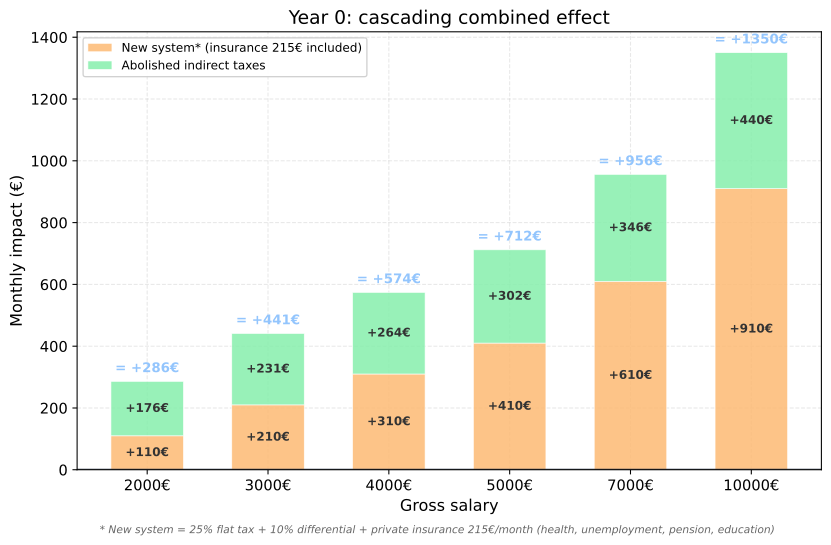 Figure E.6 — Year 0: cascading combined effect
Evolution of Purchasing Power During the Transition
The following graph shows how purchasing power evolves year by year for each salary level, from year 0 until the end of the transition.
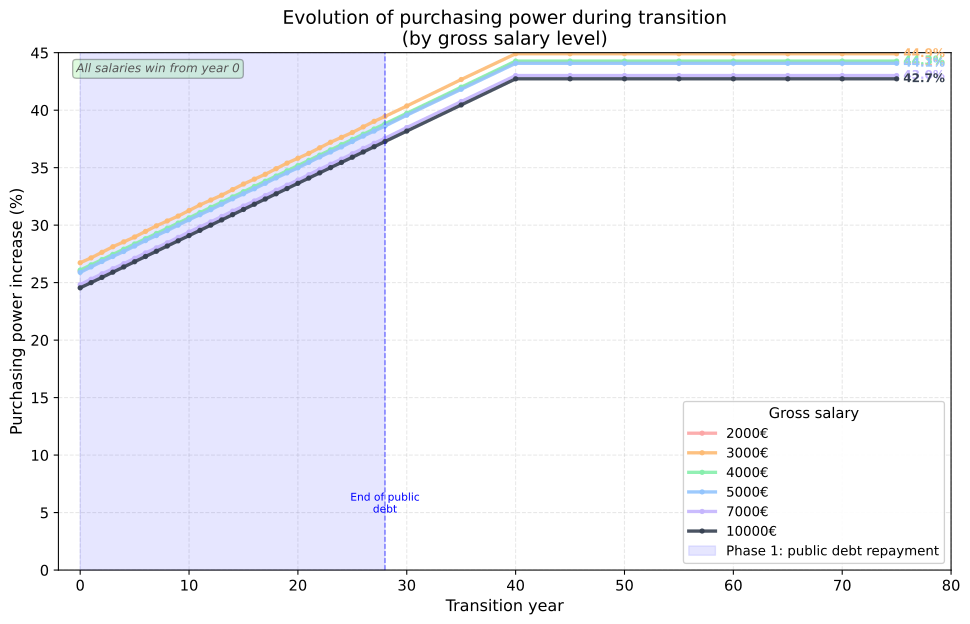 Figure E.7 — Evolution of purchasing power during the transition
Purchasing Power Gain at End of Transition
| Gross Salary | Current Net | Final Net | Gain €/month | Gain % |
|---|---|---|---|---|
| 2000€ | 1100€ | 1583€ | +483€ | +43.9% |
| 3000€ | 1650€ | 2386€ | +736€ | +44.6% |
| 4000€ | 2200€ | 3168€ | +968€ | +44.0% |
| 5000€ | 2750€ | 3954€ | +1204€ | +43.8% |
| 7000€ | 3850€ | 5495€ | +1645€ | +42.7% |
| 10000€ | 5500€ | 7834€ | +2334€ | +42.4% |
| Tableau E.4 — Purchasing power gain at end of transition |
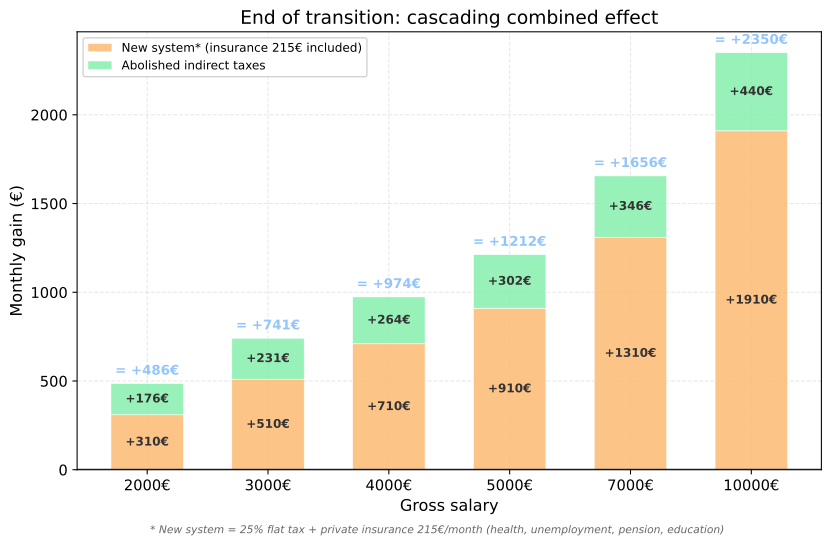 Figure E.8 — End of transition: cascading combined effect
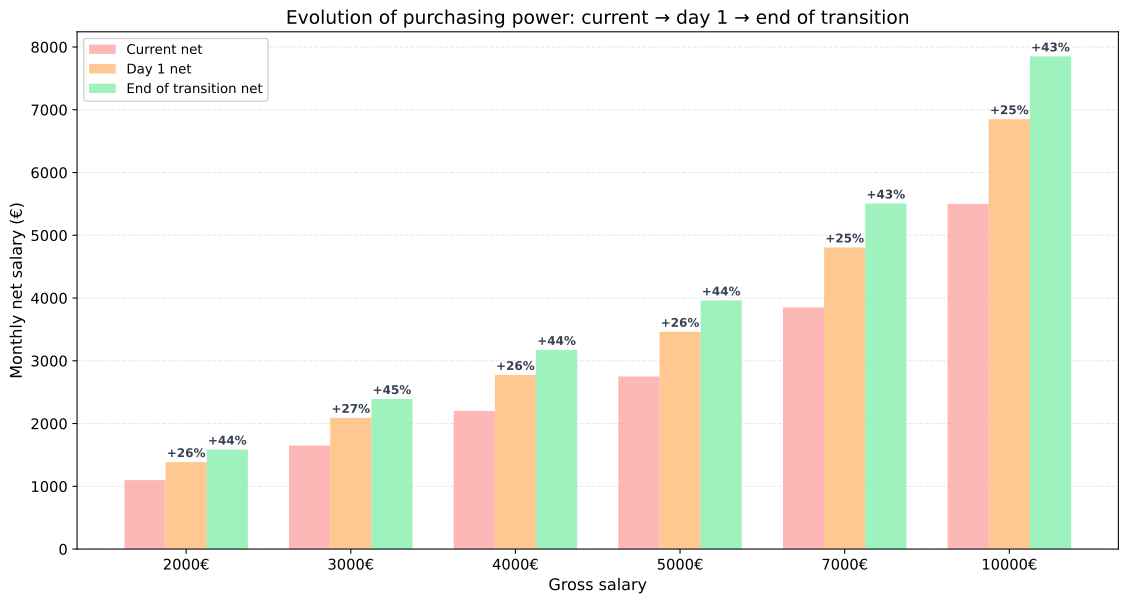 Figure E.9 — Purchasing power gain at end of transition
The relative gain is more favorable to low incomes. The abolition of indirect taxes represents +16% of net for a €2000 salary, versus only +8% for a €10,000 salary. Regressive taxes weighed proportionally heavier on small budgets — their suppression naturally rebalances the system.
No corrective mechanism is necessary. The system is fair from the start. Any breach of the single-rate principle (flat tax) would open a Pandora’s box that could be exploited to corrupt the system in the future.
E.5 — Key Parameters
What accelerates the transition:
- Privatizations (sale of public assets to repay debt)
- Stronger economic growth
- Solidarity pension reduction (e.g., -10%)
- Later retirement age
What slows the transition:
- High initial public debt
- High implicit debt (pension promises)
- Low growth
- Rapid demographic aging
What doesn’t change the final result:
- The differential profile (linear or progressive)
- The method of calculating proportional rights
The transition succeeds in all cases. Only the duration varies.
Note on the growth scenario. The simulation uses a moderate growth assumption (approximately 3.5% nominal). This scenario is probably pessimistic. Indeed, with the shift to flat tax and the massive reduction in mandatory levies, many countries will find themselves on the right side of the peak of the Laffer curve [80]: lighter taxation stimulates economic activity, broadens the tax base, and can even increase total revenues. Real growth could therefore be higher than projections, which would accelerate debt repayment and facilitate the transition.
Effect on low salaries. Faster growth also means faster salary increases for everyone, including low incomes. They would therefore benefit more from the new social contract than what the simulations show. Moreover, as demonstrated in the “Combined Effect” table, the abolition of indirect taxes benefits low incomes proportionally more (+16% of net for a €2000 salary vs +8% for €10,000). The system is therefore naturally more favorable to small budgets — without any corrective mechanism being necessary.
Reminder: the effect of indirect taxes changes everything. As demonstrated in the “Combined Effect” table above, the abolition of indirect taxes (VAT, excises, property taxes) — which weigh proportionally more on low incomes [81][82] — completely transforms the balance. Even the most modest salary is a winner from day one of the transition (+142€/month for a gross salary of €2000).
E.6 — Purchasing Power Neutrality and Reduced Financing Need
Key principle (see Chapter VIII). The model reasons in net purchasing power, not nominal amounts. The abolition of indirect taxes means that a nominally lower pension in the new system can offer the same purchasing power — or even higher — than in the old one. A €1,200 pension without VAT can be worth as much as a €1,500 pension in a system with 20% consumption taxes.
Consequence for the transition: The real flow needed to finance pensions inherited from the old system is reduced. The temporary differential is lightened — without reduction in retirees’ effective economic rights. This is not a “pension cut” — it’s an adaptation to the new fiscal framework.
E.7 — Acquired Rights are Respected
Current retirees. They keep their pensions (possibly reduced by 10% through “solidarity reduction”). Nothing changes for them, except the funding source.
Workers close to retirement. They have proportional rights to their years of contribution in the old system. These rights are honored.
Young workers. They move directly to capitalization. They owe nothing to anyone and recover what they save.
E.8 — Conclusion: It’s Feasible — And Demonstrated
A complete simulator modeled this transition for 7 European countries, with explicit parameters and verifiable source code. The results are consistent and robust:
- Demonstrated feasibility: all debts (public and implicit) converge to zero
- Reasonable duration: 70 to 85 years (2 to 3 generations), except extreme cases
- Bearable temporary effort: differential of 8-11% of GDP for 40 years
- Final gain for all: 33 to 41% more purchasing power at arrival
- Tested robustness: even pessimistic scenarios succeed
The simulator hides nothing: assumptions are explicit, limits are documented, temporary equity problems are identified with their solutions (progressivity of the differential).
The choice is not between “pain” and “no pain”. It’s between temporary pain (the transition) and permanent pain (the collapse of the pay-as-you-go system).
E.9 — Simulator
A complete simulator allows modeling this transition for any country, with adjustable parameters (growth, demographics, privatizations, etc.). It generates year-by-year projections, salary impact tables, and visualization graphs.
The simulator is available for download: simulateur_transition_pensions.zip
For more details:
- Graphical interface user guide: Appendix F
- Methodology and model limitations: Appendix F
Return to chapter VII