C — Calculating census weight
Appendice C
CALCULATING CENSUS WEIGHT
Reference: Chapter XXII (Tax and Power: Who Pays Decides)
C.1 — The Principle
Vote weight in census elections is a function of actual tax contribution. What counts is what you contribute to the common pot, not what you earn.
C.2 — The Bounds
- Floor: 1 vote (nobody falls below)
- Ceiling: 100 votes (nobody exceeds)
C.3 — The Three-Segment Curve
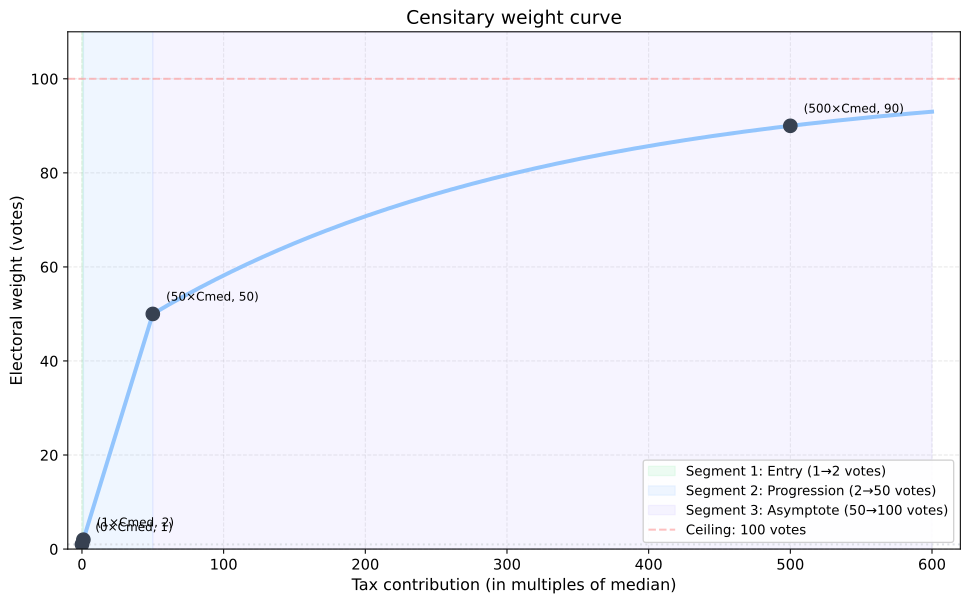
Weight P as a function of contribution C (expressed as a multiple of median contribution Cmed) follows a three-segment curve:
Segment 1: Entry into contribution (C < Cmed)
P = 1 + (C / Cmed)
Rapid rise from 1 to 2 votes. Rewards entry into contribution, even modest.
Segment 2: Regular progression (Cmed ≤ C < 50 × Cmed)
P = 2 + 48 × ((C - Cmed) / (49 × Cmed))
Linear progression from 2 to 50 votes. A taxpayer at 50 times the median has 50 votes.
Segment 3: Very large contributors (C ≥ 50 × Cmed)
P = 50 + 50 × (1 - exp(-k × (C - 50 × Cmed)))
where k is calibrated so that P reaches 90 votes when C = 500 × Cmed.
Moderate acceleration with asymptote toward 100 votes. Very large contributors gain weight, but never more than 100 votes.
C.4 — Properties of the Curve
- Continuous: no abrupt jump
- Increasing: the more you contribute, the more you weigh
- Concave on segment 3: diminishing returns for the very rich
- Bounded: absolute ceiling at 100 votes
C.5 — Weight Relative to Level of Power
The weight is calculated relative to contribution to the budget of the relevant level:
- Contribution to the national budget → weight in national elections
- Contribution to the local budget → weight in local elections
A billionaire who pays little local tax in their rural commune weighs less locally than a local entrepreneur who contributes heavily there.
C.6 — Annual Update
The weight is recalculated at each tax deadline (once a year), or in case of legislative change affecting taxes. Situations change, weight changes. This is not a fixed caste.
Return to chapter XXII