B — Elected officials' salaries and multiple offices
Appendice B
ELECTED OFFICIALS' SALARIES AND MULTIPLE OFFICES
Reference: Chapter XIX (Voting Differently: Real-Time Democracy)
B.1 — Salary Proportional to Score
Elected officials’ salary is proportional to their first-round score. If the link is linear, an official at 30% earns 30% of the reference salary. In practice, the curve will probably be logarithmic or square root: 70% is an excellent score and should approach 100% of the salary.
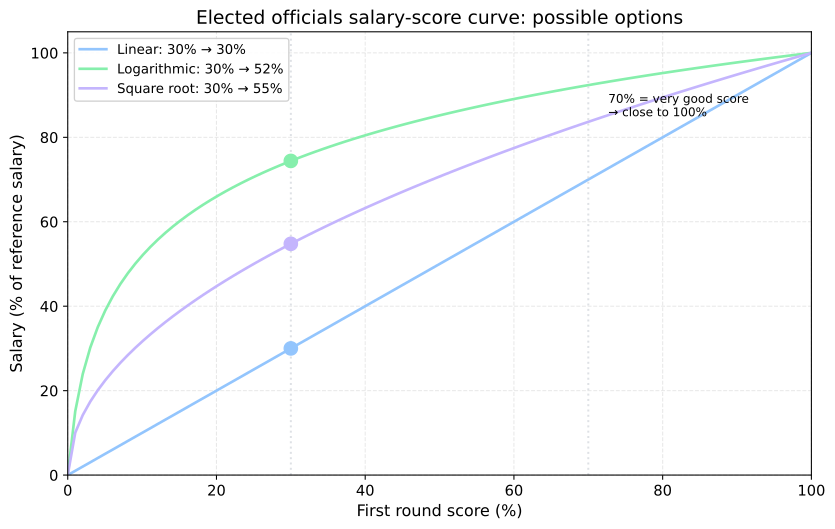 Figure B.1 — Elected officials’ salary-score curve: possible options
This curve is constitutionalized. Changing it requires a referendum.
B.2 — Calculating the Multiple Office Bonus
Let:
- R1 = reference income for the primary mandate
- R2 = reference income for the secondary mandate
- S1 = first-round score for the primary mandate
- S2 = first-round score for the secondary mandate
Primary mandate income = R1 × S1
Secondary mandate bonus = R2 × M9(S1, S2)
where M9 is the power-9 mean:
M9(S1, S2) = ((S1⁹ + S2⁹) / 2)^(1/9)
This mean tends toward the higher score, rewarding dual legitimacy.
Cap: The bonus is capped at R2 × S1. One cannot earn more on the second mandate than what would have been earned with the first mandate’s score.
Total income = R1 × S1 + min(R2 × M9, R2 × S1)
B.3 — Numerical Example
A national official at 45% (R1 = €10,000) and local at 60% (R2 = €3,000):
- Primary mandate income: 10,000 × 0.45 = €4,500
- M9(0.45, 0.60) = ((0.45⁹ + 0.60⁹) / 2)^(1/9) ≈ 0.57
- Theoretical bonus: 3,000 × 0.57 = €1,710
- Cap: 3,000 × 0.45 = €1,350
- Applied bonus: min(1,710, 1,350) = €1,350
Total income: €4,500 + €1,350 = €5,850
Instead of €4,500 for a single mandate. Multiple offices bring real added value, but capped.
B.4 — Why the Power-9 Mean?
The high power means that the M9 average is very close to the maximum of the two scores. This strongly rewards dual legitimacy when both scores are high, while limiting the bonus when one score is low.
- If S1 = S2, then M9 = S1 = S2 (no additional bonus)
- If S1 « S2, then M9 ≈ S2 × 0.89 (the small score “pulls” slightly downward)
- If S1 and S2 are both high, M9 ≈ max(S1, S2)
Return to chapter XIX